
What Happens When You Drive Over a Bridge?
STRUCTURES
Travis Basnett, PE · Licensed in SC, NC & GA · October 13, 2026 · 8-minute read
You cross bridges every day without thinking about them. Follow the weight of your car from the tire to the dirt, and you can see what each part is doing.
You've felt it a thousand times. The road is smooth, then there's a thump as your tires reach the bridge, and sometimes another as you leave it.
Most people assume that bump is the gap where the bridge meets the road. Sometimes it is. Often it's something else, and the answer has to do with where your car's weight actually goes.
A bridge has one job: take the weight on top of it and hand it, piece by piece, down to the ground.
Every part you can see, and plenty you can't, is a step in that handoff. Follow your car's weight from the tire to the dirt and the bridge starts to make sense. So does the bump.
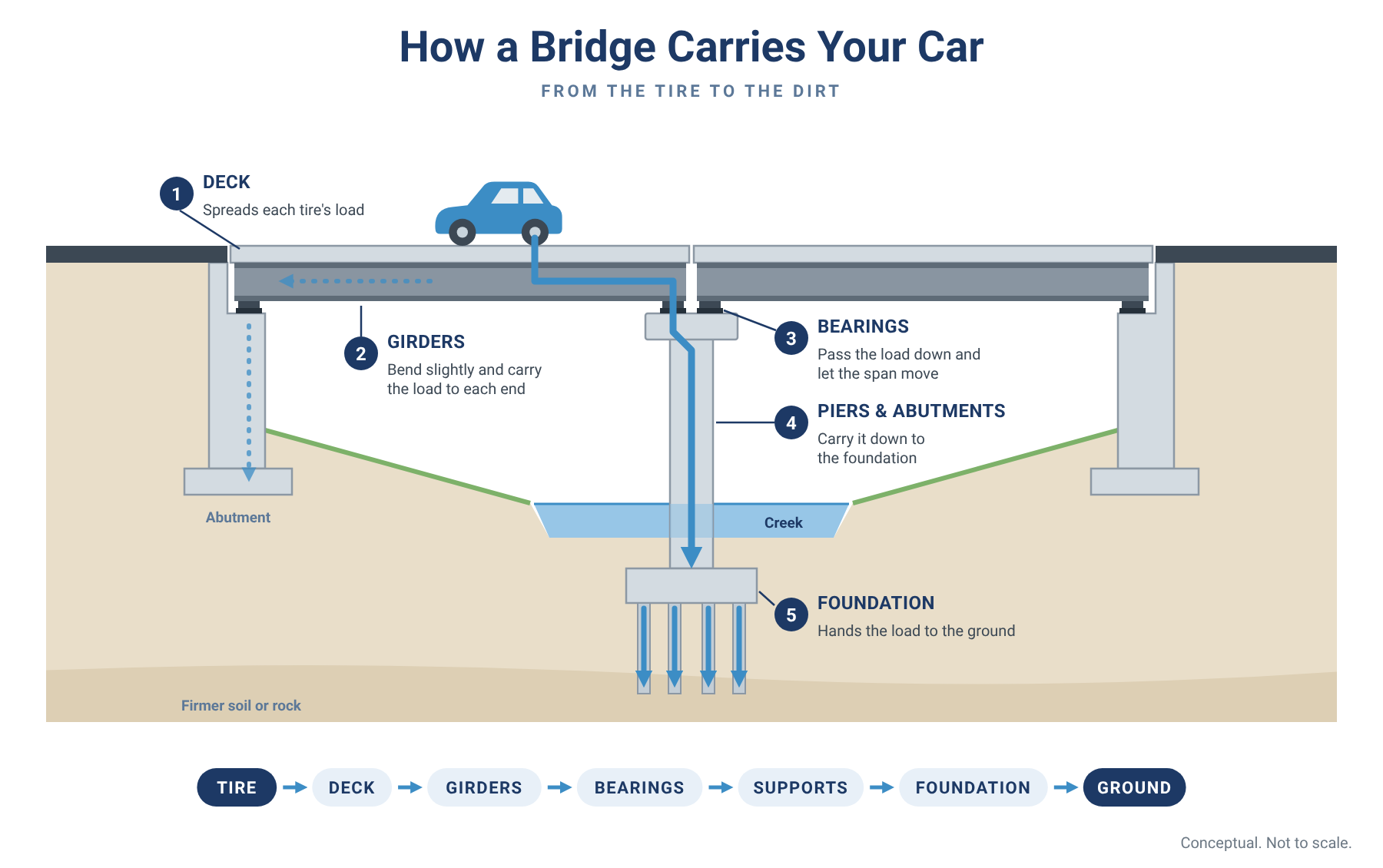
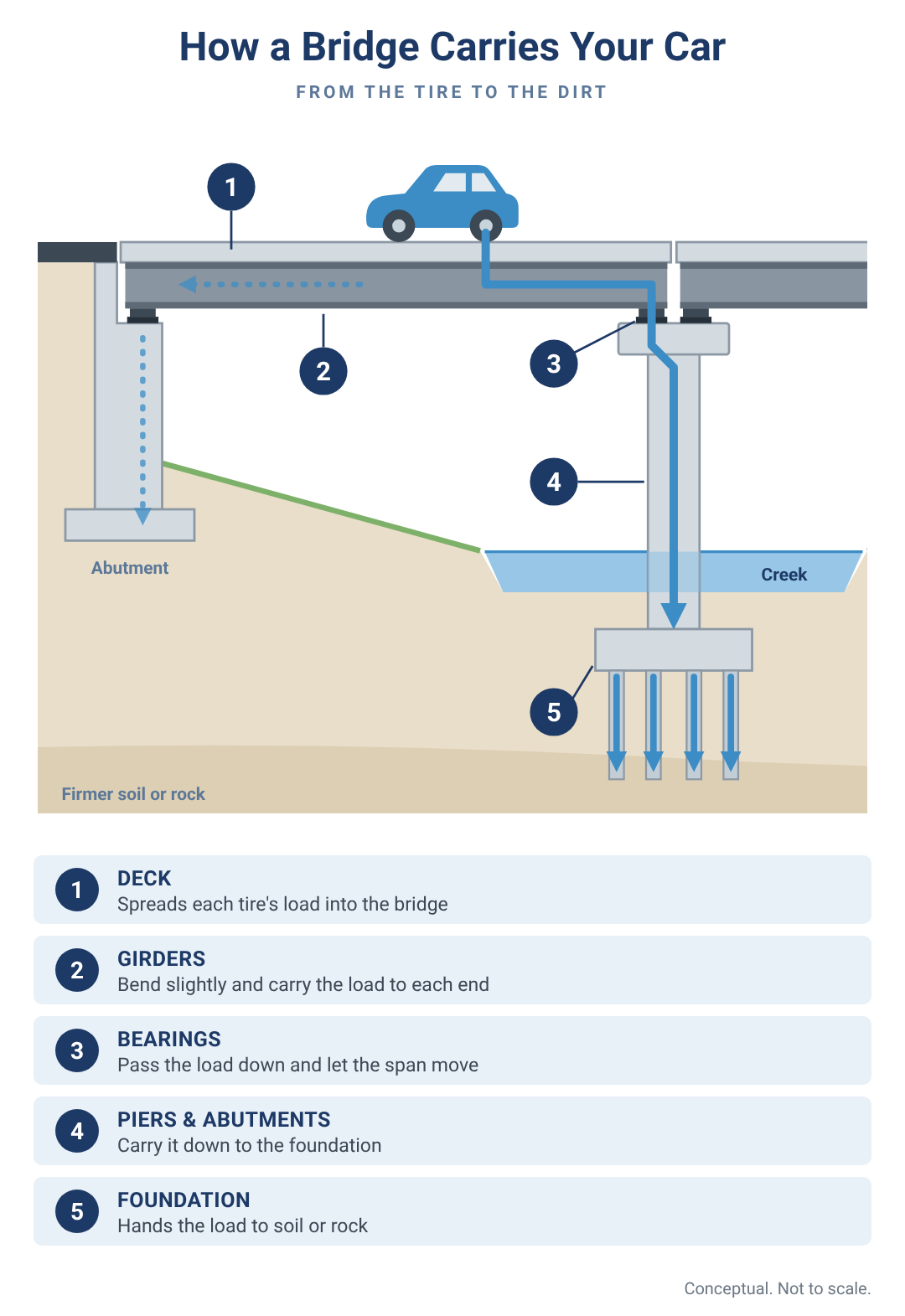
Figure 1. Your car's weight passes from the deck to the girders, through the bearings to the supports, and down through the foundation into the ground. Conceptual illustration.
Your tire meets the deck
The deck is the part you drive on. On most highway bridges, it's a concrete slab.
Each tire presses on a patch of pavement about the size of a postcard. The deck spreads that load over a larger part of the bridge and passes it into the structural members underneath. That's the first handoff.
Why the bridge ices before the road
You've seen the sign. Here's why it's true. The road sits on the ground, and the ground holds heat. A bridge deck has cold air above it and cold air below it, so it loses heat from both sides. It can ice over while the road next to it is still just wet.
The deck hands off to the girders
Under the deck are the girders, the long beams that run from one support to the next. On most bridges you drive over, they're steel or concrete.
When your car rolls onto a span, the girders bend slightly under it. In a typical span, the top of each girder gets squeezed and the bottom gets stretched, the way a ruler flexes when you press on its middle.
That flex is normal. A bridge is not supposed to be perfectly rigid. Under traffic, its parts give a little and then return. If you've ever stood on a bridge while a loaded truck went by and felt it move, that's what you felt. Good bridges move in controlled ways.
The girder doesn't keep the load. At each end, it has to hand it on.
Traffic isn't the only thing that moves a bridge
Concrete and steel grow when they warm up and shrink when they cool. Over a long bridge, that adds up. Over an 80-degree temperature swing, a 300-foot steel span can change length by roughly two inches.
Lock a bridge rigidly in place and that movement has nowhere to go. It pushes and pulls on everything around it.
So many bridges sit on bearings where the girders meet their supports. A bearing passes the girder's load down while letting it slide or rotate slightly as it grows and shrinks. Some bridges are built to handle this movement another way, but the goal is the same.
The expansion joint does the same job at the surface. It's the gap, usually covered by a steel plate or a rubber seal, that lets the deck lengthen and shorten without cracking. That clack you hear crossing some bridges is often the joint.
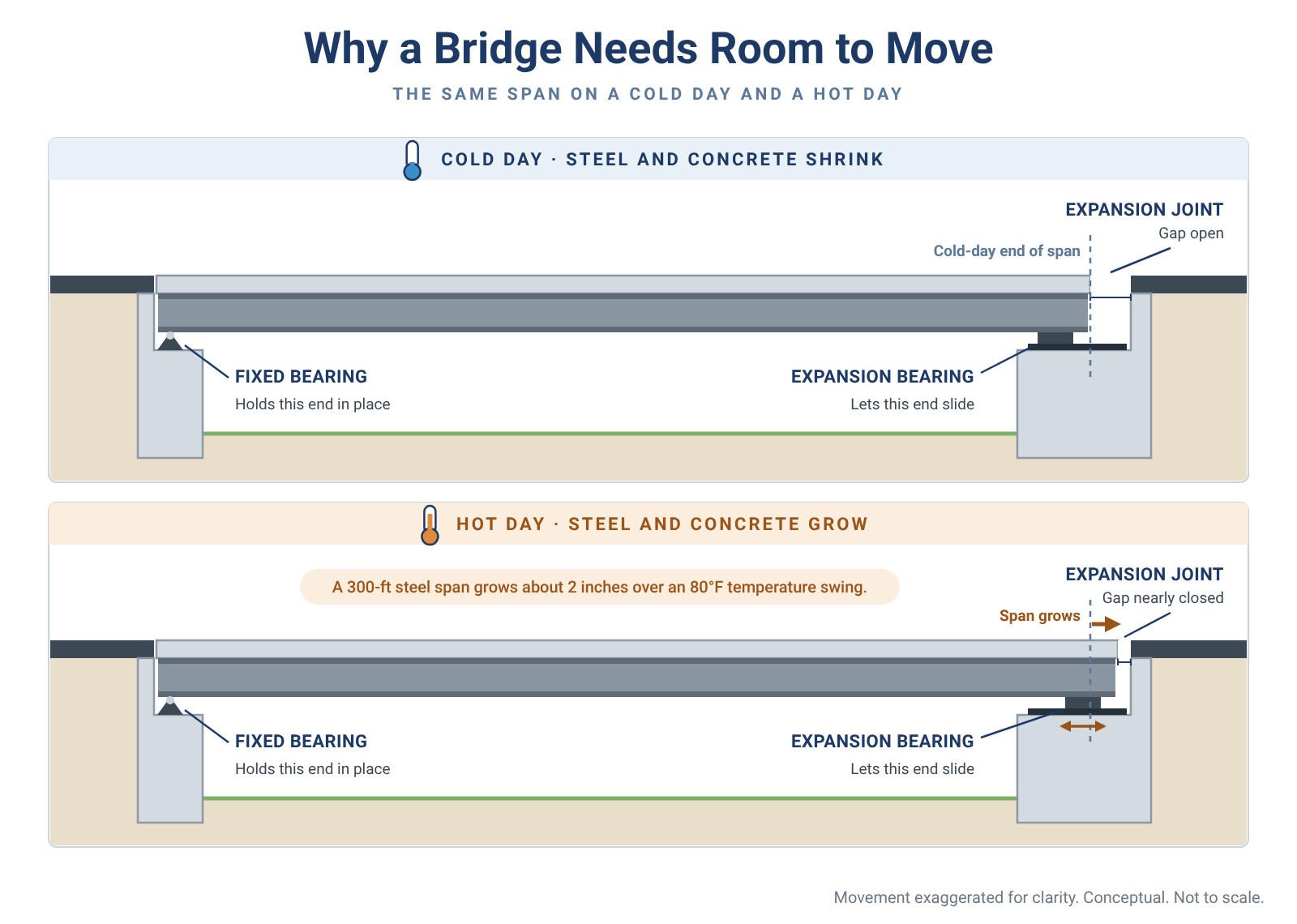
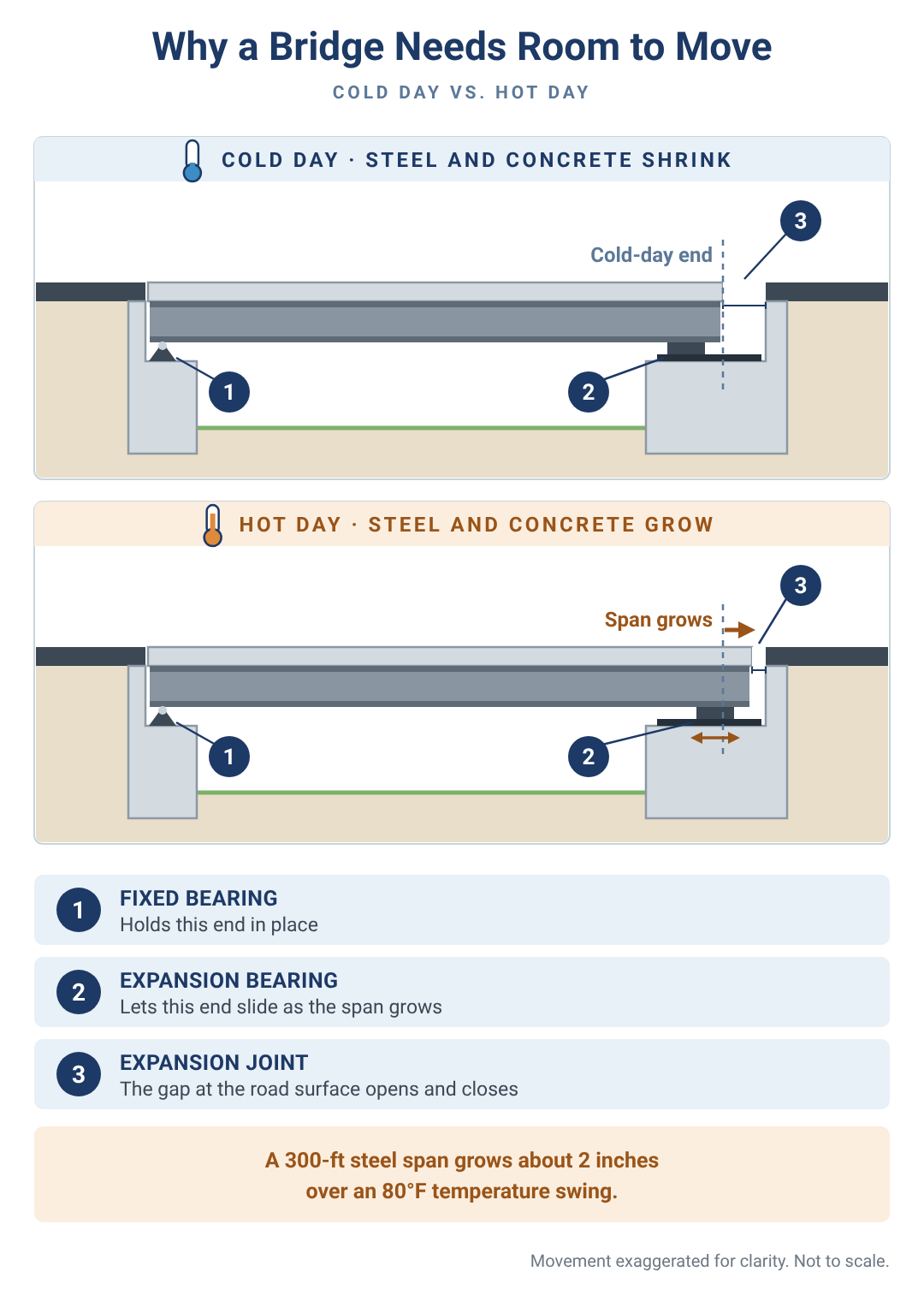
Figure 2. The same span on a cold day and a hot day. As the girder lengthens, the bearing lets it move and the joint gap closes. Movement exaggerated for clarity.
Piers, abutments, and the bump
From the bearings, the load goes into the supports. Piers are the supports in the middle, the columns you see standing in a river or between the lanes of the road below. Abutments are the supports at each end. They carry the bridge and also hold back the earth behind it.
Now back to the bump.
The bridge and the road leading up to it are supported differently. The bridge sits on engineered foundations, often reaching down into firmer material. The road leading up to it usually sits on compacted fill, a raised bank of soil. Over time, that fill and the soil beneath it can settle more than the bridge does. The approach sinks, the bridge stays relatively put, and a step can form where they meet.
Engineers often place a reinforced concrete slab between the road and the bridge to smooth that transition. The approach can still settle differently over time, and when it does, you feel it.
So the next time you feel that bump, look at the road leading up to the bridge. It's often sitting a little lower than the bridge it meets.
The foundation hands it to the ground
Under every pier and abutment is a foundation. Its job is the last handoff.
Some foundations spread the load near the surface, on a wide pad of concrete. Others use long concrete or steel members, driven or drilled deep underground until they reach material strong enough to carry the load. Which one an engineer chooses depends mostly on the soil.
That's the whole trip. The tire hands the load to the deck. The deck hands it to the girders, the girders to the bearings, the bearings to the piers and abutments, and those to the foundation. The foundation hands it to the earth.
Every pound of your car ends up in soil or rock.
When water takes the ground away
We just followed your car's weight into the ground. What happens if moving water removes some of that ground?
That's scour. When a river rises and speeds up, it can carry away the soil and sand around a bridge's piers and abutments. The streambed around the support drops, and more of the foundation is exposed.
Scour doesn't usually mean a foundation suddenly loses everything holding it up. The foundation may still extend deep underground, but it has lost some of the material it was designed to work with. If enough goes, the bridge can become unsafe. According to the Federal Highway Administration, scour is the most common cause of bridge failure in the United States.
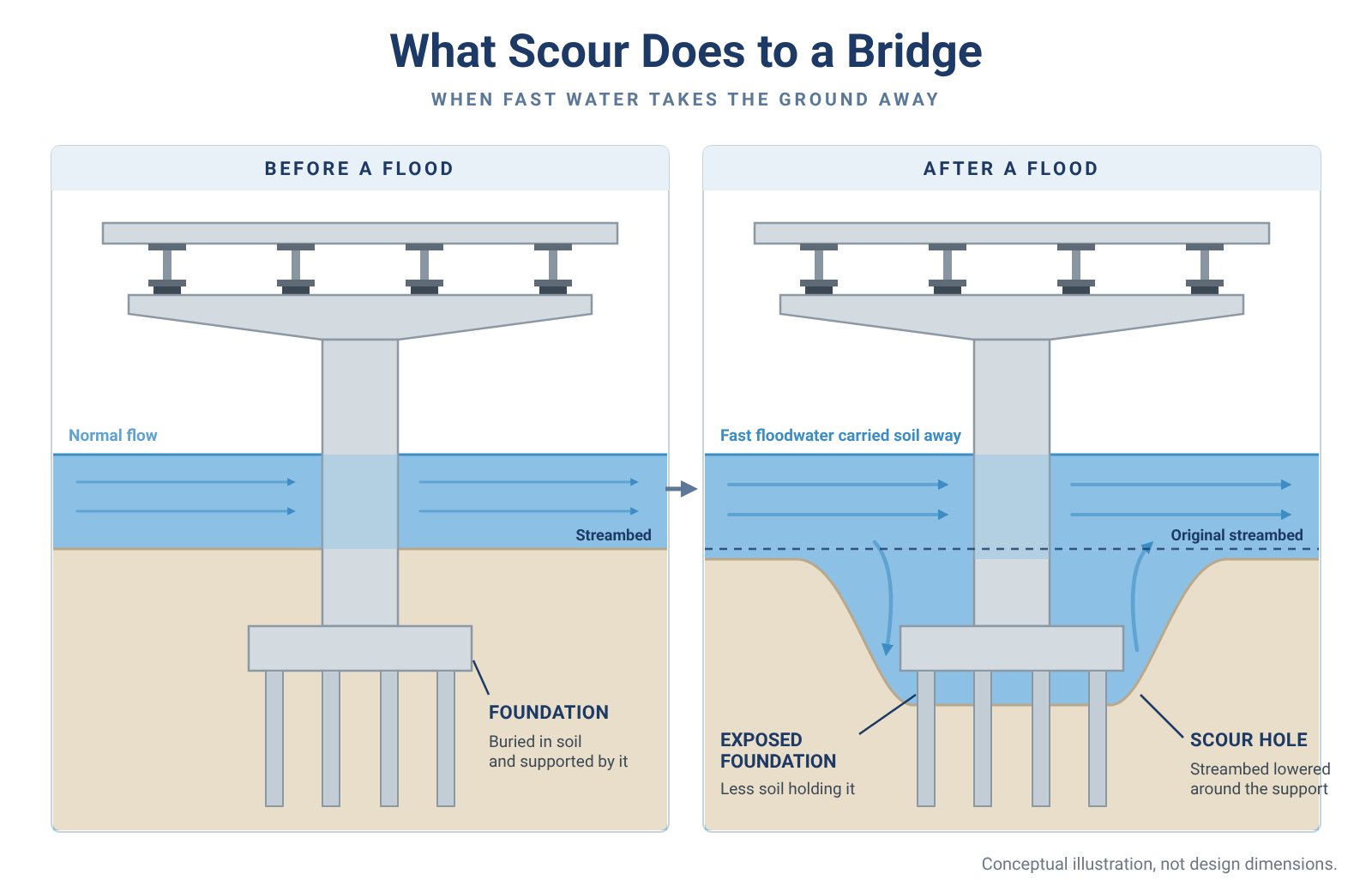
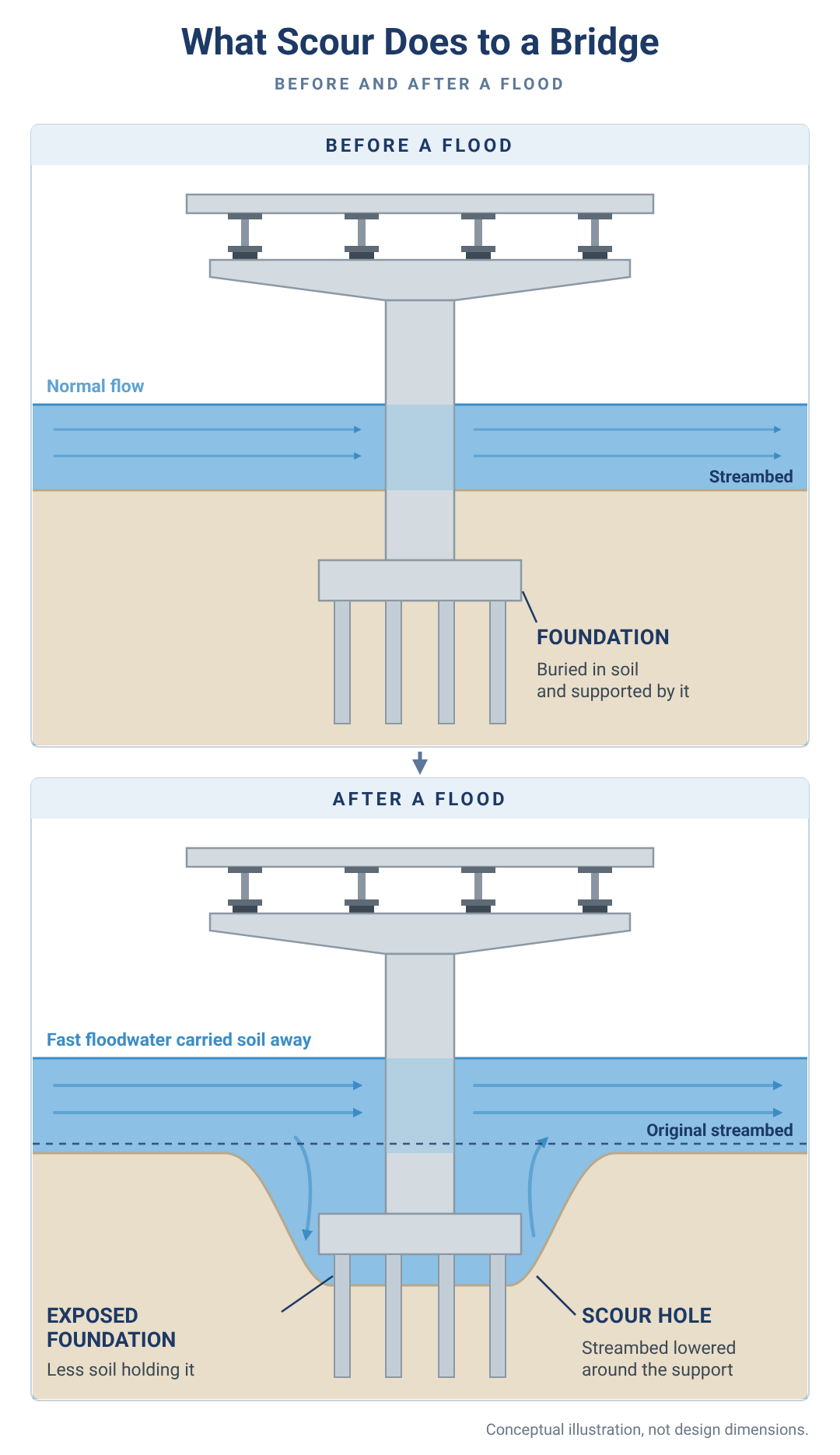
Figure 3. Before a flood, the streambed sits high around the pier. After, fast water has lowered the streambed around the support and exposed more of the foundation. Conceptual illustration, not design dimensions.
South Carolina saw this up close in October 2015. At the flood's peak, 541 roads and bridges across the state were closed, including stretches of interstate. SCDOT counted 221 bridge sites affected. Along I-95 in Clarendon County, SCDOT crews and six concrete pump trucks worked around the clock to shore up bridge pilings affected by the flooding.
If you read What Happens When It Rains?, you followed water off roofs and streets into Columbia's drainage system and on to the Congaree. This is the other end of that story: the same water, moving fast, working on the ground a bridge stands on.
How engineers keep watch
The parts that matter most are often underwater or underground, so a bridge can't be judged by how it looks from the road.
Public highway bridges are inspected on a regular schedule under federal standards. For decades, the familiar routine interval was every two years. Today federal standards use a risk-based system, so some bridges are inspected more often and some can go longer between routine inspections. After a major flood, bridges over affected streams get checked for scour.
What the weight-limit sign means
On some smaller bridges, especially on rural roads, you'll see a sign with a weight limit. It means engineers have determined that certain heavier vehicles can't use that bridge without restriction.
That doesn't mean the bridge is about to fail. Someone checked what it can safely carry and posted the answer where drivers can see it.
A different route to the same place
Most bridges you drive over work the way we just followed: deck, girders, supports, foundation.
The Gervais Street Bridge over the Congaree works differently. Completed in 1928, it carries its load on a row of concrete arches. Instead of bending like a girder, an arch carries the weight mostly by squeezing it along its curve, down toward the supports at each end.
Different shape, different behavior, same destination: the ground.
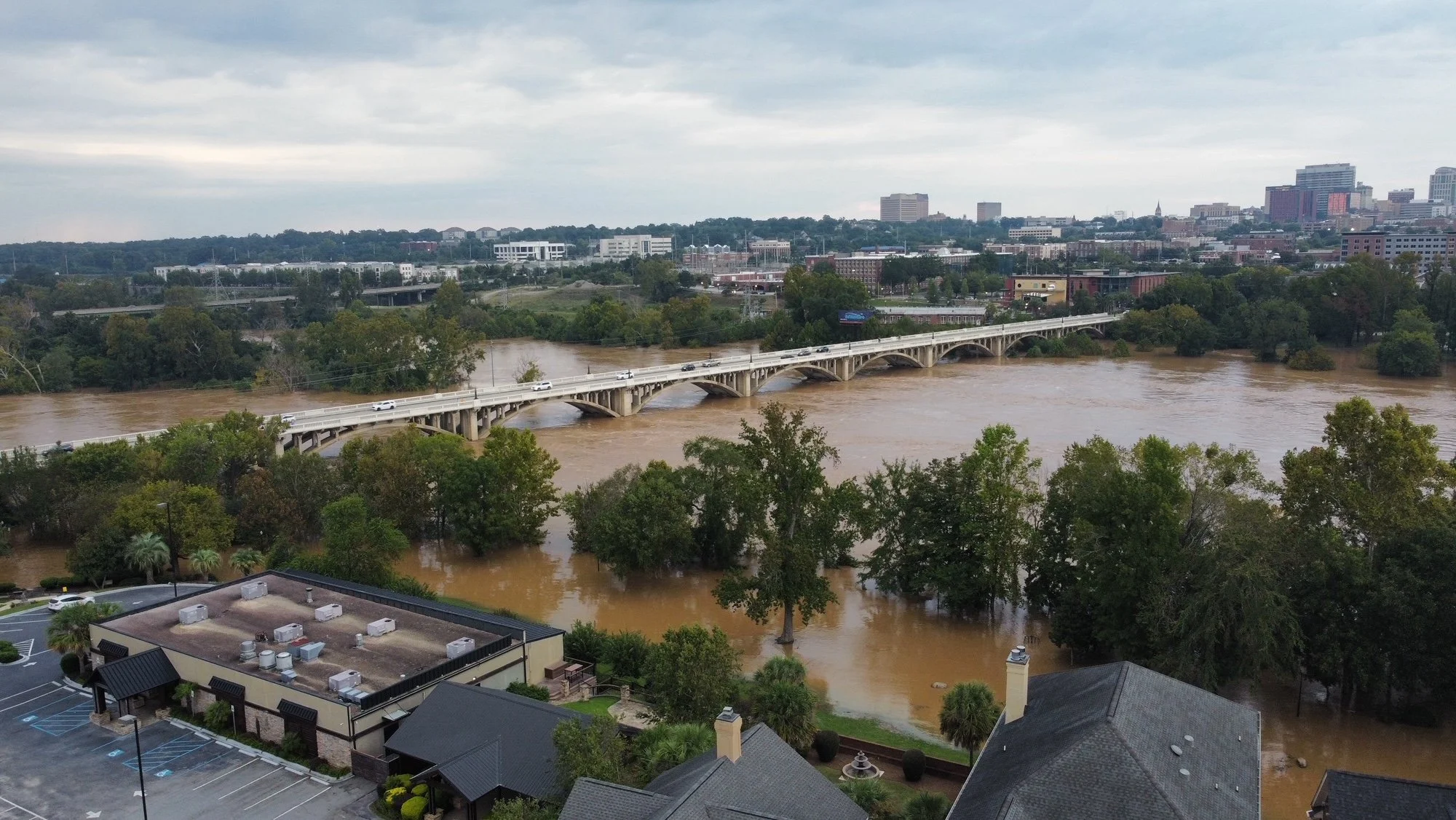
Gervais Street Bridge during Hurricane Helene flooding, September 2024. The Congaree River crested at 30.58 feet at the Columbia gauge on September 30. The bridge’s concrete arches transfer vehicle loads toward the supports, while its foundations must also withstand the effects of the river below. Photo by the author.
The weight always finds the ground
Steel or concrete, beam or arch, an overpass on I-26 or a century-old river crossing: the path changes from bridge to bridge. The rule never does. Every bridge is a way of carrying you across something while handing your weight, piece by piece, to the ground underneath.
The next time you feel that bump, you'll know where your weight went, and why the road leading up to the bridge might be sitting a little lower than it used to.
Sources
South Carolina Department of Transportation, FY2015-16 Accountability Report: peak road and bridge closures during the October 2015 flood.
South Carolina Department of Insurance, 2015 Coastal Property Report: bridge sites affected, citing SCDOT.
South Carolina Department of Transportation, flood coverage in SCDOT News: repairs to I-95 bridge supports in Clarendon County.
Federal Highway Administration, Risk-Based Scour Program companion guide: scour as the most common cause of bridge failure.
Federal Highway Administration, National Bridge Inspection Standards final rule, Federal Register, May 6, 2022: risk-based inspection intervals.
National Register of Historic Places, Gervais Street Bridge, listed November 25, 1980: construction dates and arch design.
National Weather Service, September 2024 Climate Summary: Congaree River at Columbia crest during Hurricane Helene.
From the same series
What Happens When You Turn On the Faucet? Follow the public water system backward, from the tap to its source.
What Happens After You Flush? Follow wastewater in the other direction.
What Happens When It Rains? Where rain goes after it falls.
What Happens When You Drive to Work? Why every road on your commute is built for a different job.
This article is part of a series explaining how the systems around us actually work, written for people who are not engineers.
Next: What Infrastructure Does a Data Center Actually Use?
