
What Happens After You Flush?
WASTEWATER
Travis Basnett, PE · Licensed in SC, NC & GA · September 16, 2026 · 8-minute read
A flush is the first few feet of a chain that ends in a river. Here is the whole chain, forward.
The last article followed a glass of tap water backward, from your kitchen sink to a river. This one runs the other direction.
Push the handle on a toilet and you get about a second and a half of noise, and then the problem is gone. Where it goes after that is a question almost nobody asks, which is strange, because we ask a version of it constantly about everything else we throw away. Most people can tell you roughly where their trash ends up. Very few can tell you where their wastewater ends up, even though they send it off far more often.
That water is going somewhere specific. It will travel through your own plumbing, cross into a public pipe under your street, join progressively larger pipes, very likely get lifted uphill at least once by a pump, arrive at a treatment plant, and then be handed back to a river a few miles from where it started.
We are going to follow the whole trip, forward, from the bowl to the Congaree.
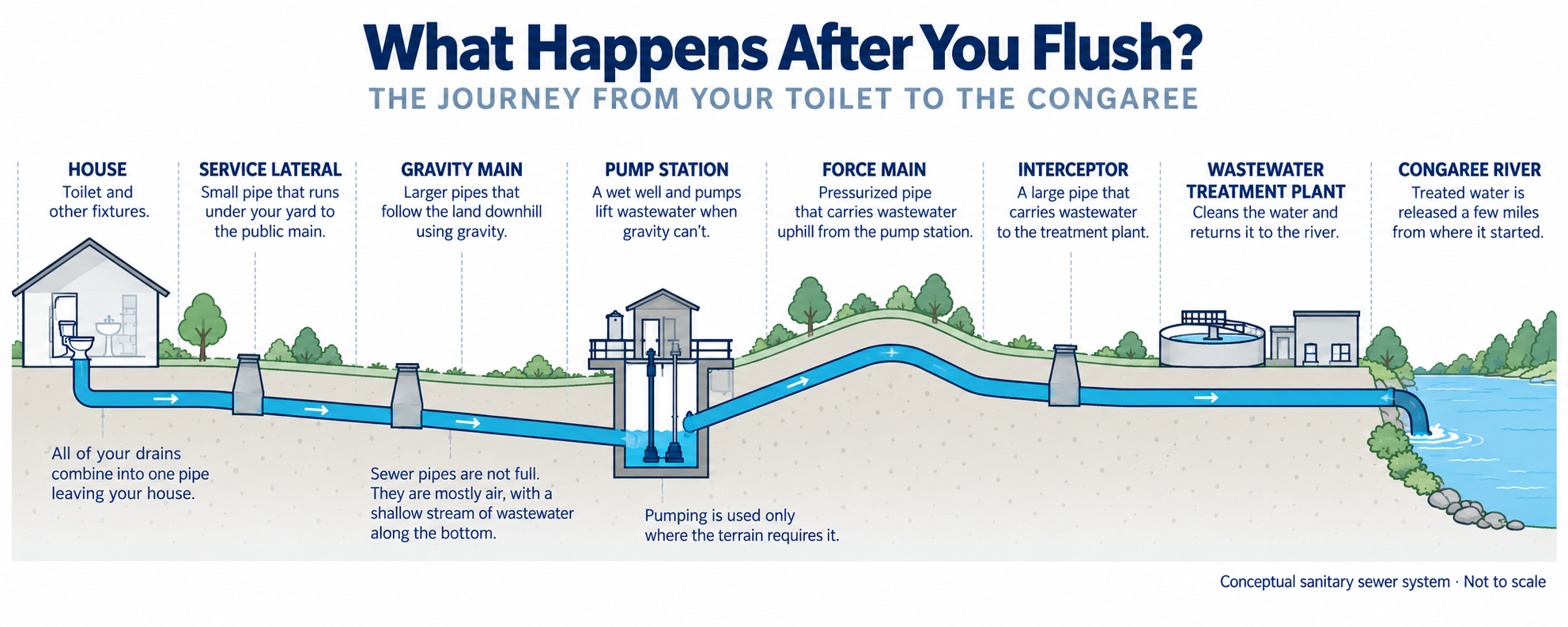
Figure 1. The whole chain, from fixture to river. Wastewater moves from small service laterals into progressively larger mains, with pumping where the terrain requires it.
Nothing pushes it
Start with the same kind of question the last article started with, because the answer is the exact opposite.
A water main is full. It is full right now, it has been full all night, and it is under pressure. Turning on your faucet does not go get water. It opens a hole in a system that was already pressurized and waiting.
A sewer is the reverse of that in almost every way. It is not full. It is not under pressure. Nothing is waiting in it. A sewer pipe is mostly air, with a shallow stream of water running along the bottom of it, and the only reason that stream moves at all is that someone buried the pipe at a slope and let gravity do the rest.
That is the whole trick. Design standards commonly set the minimum slope on an eight-inch sewer at around four tenths of a percent, which is roughly five inches of drop across a hundred feet of pipe. It is not much. It is enough.
That number is not arbitrary. The slope is chosen so the pipe holds about two feet per second when flowing full. The idea is to make the sewer self-cleansing, keeping solids moving instead of letting them settle out.
Hold onto that, because later in this article something is going to defeat it.
Your water system ignores the terrain. Your sewer system obeys it.
A water main will happily climb a hill, because there is energy behind it. A gravity sewer cannot climb anything. It goes where downhill goes, which means the sewer network under a city is shaped less like a utility and more like a watershed. It follows the low ground. It runs down valleys and along creeks and through the backs of properties, because that is where the land falls.
If you have ever walked a greenway and noticed a line of manhole lids following the creek, that was not a coincidence and it was not convenience. That was the terrain deciding where the pipe went.
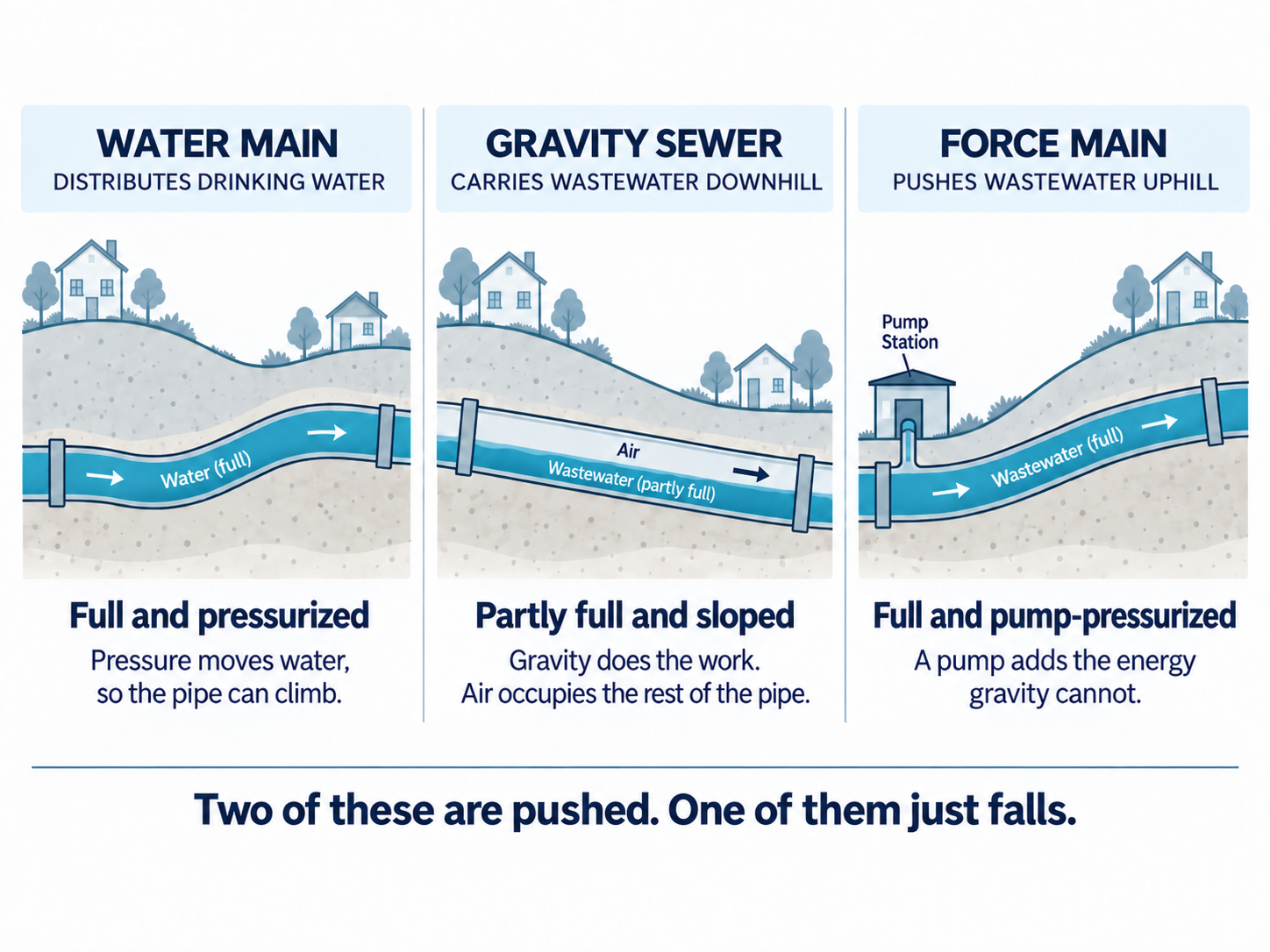
Figure 2. The same neighborhood, three pipes, three different ways of moving water. Only the middle one depends on the shape of the ground.
The first six inches
Before any of that, there is the part inside your house, and there is one piece of it worth understanding.
The water sitting in the bottom of your toilet bowl is not left over from the last flush. It is a seal. Every fixture in your house, including every sink, tub, and floor drain, has a bend in the pipe behind it that stays full of water on purpose (usually a P-trap). That trapped water is the only thing separating the air in your bathroom from the air in the sewer, and sewer air is not something you want in a bathroom.
So the bowl is not holding water. It is holding a door shut.
That also explains something on your roof. The pipe sticking up through your shingles is not a chimney. It is a vent connected to your drain system, and it does two jobs. It gives sewer gases a path to the outdoors, well above anybody's window. And during drainage, its most important job is pressure equalization. It lets air move into and out of the drain system as water flows through it, so a large slug of draining water cannot pull a vacuum behind it and siphon the traps dry. Without it, you would find out very quickly what the traps were for.
Drainage plumbing needs air almost as much as it needs slope.
One pipe, not several
Most people picture the toilet having its own dedicated line to somewhere. It does not.
The toilet, the shower, the bathroom sink, the kitchen sink, the dishwasher, and the washing machine all drain into the same system inside your walls, and that system combines into a single pipe leaving your house. That pipe is called the service lateral, and it runs under your yard to the public main in the street or in an easement behind you.
Two things follow from that, and both of them surprise people.
The first is that a clog in your lateral affects everything at once. When a lateral backs up, it does not back up politely at the fixture that caused it. It backs up at the lowest opening in the house, which is usually a downstairs shower or a floor drain.
The second is ownership. In many systems, some or all of the lateral on private property is the homeowner's responsibility rather than the utility's. Exactly where public responsibility ends varies by utility, and the arrangements around here vary quite a bit. In newer construction you will often find a cleanout near the right-of-way line, which is a useful clue about where the split falls. Either way, roots in a sixty-year-old clay lateral are frequently a homeowner expense, and a lot of people learn that for the first time on a bad Saturday.
Where gravity runs out
Gravity is free, reliable, and has no moving parts, which makes it the best thing in the business. It has one limitation: it only works downhill, and land eventually stops cooperating.
When a service area drains toward a low point that has nothing lower left to reach, the wastewater has to be lifted. That is what a pump station does. You have driven past dozens of them. They are usually small fenced enclosures with a control panel, a hatch or two in a concrete slab, and nothing to look at. Underneath is a wet well that collects incoming flow and pumps that switch on when the level rises.
From the pump station, the wastewater leaves in a force main, which is the one part of the collection system that behaves like a water line. It is full, it is under pressure, and it can climb. It carries flow up and over the ridge to the next point where gravity can take over again.
Do that enough times across a city and the branches keep combining into larger and larger pipes. The largest of them are called interceptors, and they usually run along a river or a major creek, gathering flow from everything upstream and carrying it to the plant. An interceptor is the trunk of the whole tree.
Columbia's system runs roughly sixty pump stations across about 1,100 miles of pipe serving around 63,000 connections. Almost all of that mileage is gravity. The pumping is the exception, used where the topography leaves no other option.
It is worth noticing what that means for reliability. A gravity sewer has no parts to break. A pump station has motors, controls, power service, and alarms, and it needs all of them working. Every place the system borrows pressure is a place that needs power, monitoring, and somebody available at two in the morning.
Two pipes under the same street
Here is the misconception that matters most, and the one I would most like people to walk away with.
The grate at the curb does not go to the treatment plant.
In most of Columbia, and in most cities built or rebuilt in the last several decades, there are two entirely separate underground networks. The sanitary sewer carries what leaves buildings, and it goes to a treatment plant. The storm drain system carries rainwater off streets and parking lots, and it ends up in the nearest creek.
They are different pipes, in different alignments, at different depths, built under different rules, and they are not supposed to touch.
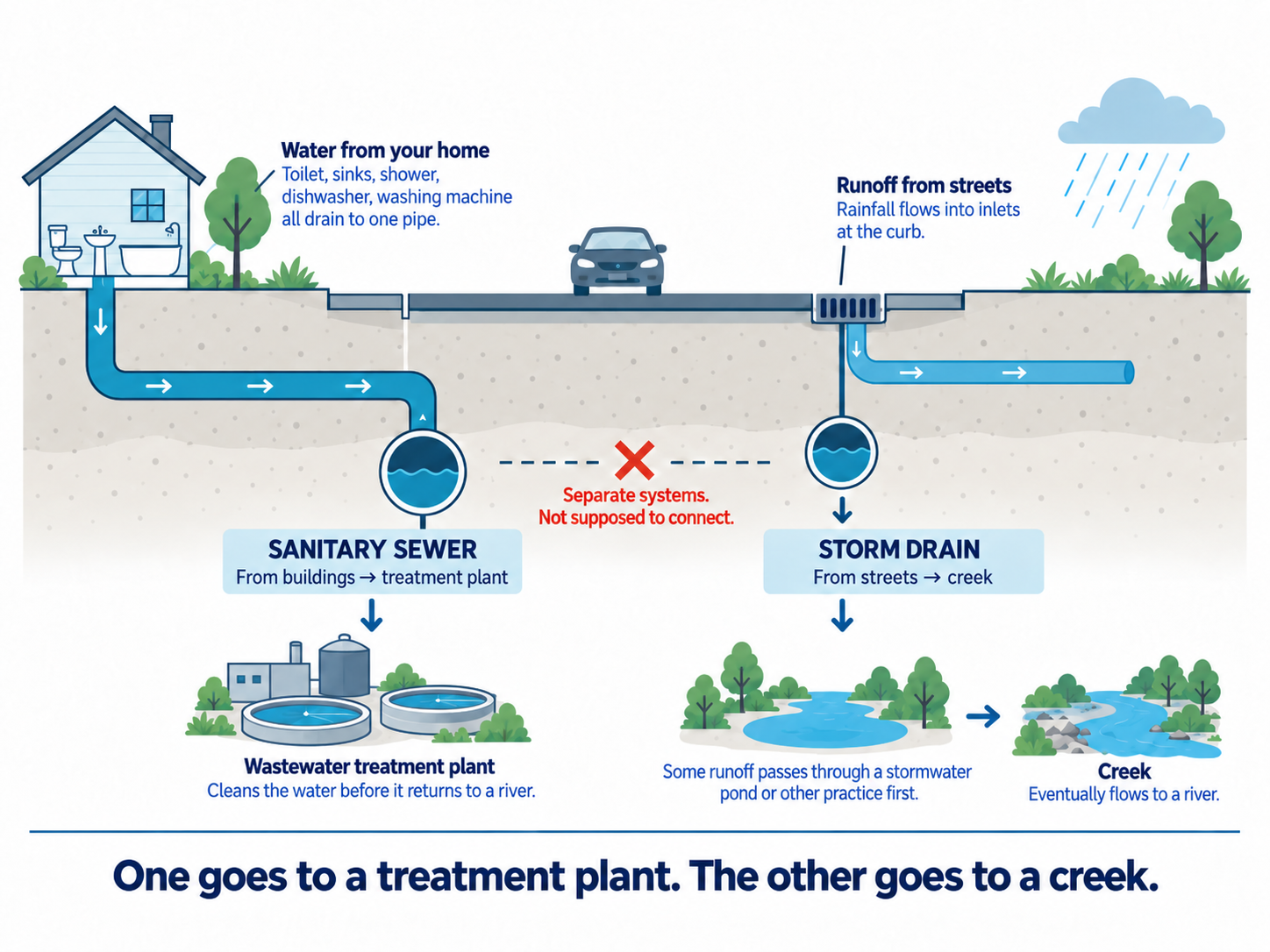
Figure 3. Sanitary and storm are separate systems with separate destinations. What goes into a curb inlet reaches a stream, sometimes by way of a stormwater pond, but never by way of a wastewater plant.
This is why pouring anything down a storm drain is a genuinely bad idea, and why the paint or oil or soapy bucket does not get cleaned up somewhere downstream. There is no wastewater plant waiting downstream. At most, the runoff may pass through a stormwater pond or another treatment practice before it reaches a creek.
Some older cities, mostly in the Northeast and Midwest, were built with combined systems that carry sewage and stormwater in the same pipe, which creates a very specific set of wet weather problems. That is not the general condition here. Which raises an obvious question, since our systems are separate: why does rain cause sewer problems at all?
Why sewers overflow
Most sewer overflows come down to one of two basic problems. Either the system cannot carry what is trying to pass through it, or there is far more water in it than it was ever designed to carry.
The first category is broader than it sounds. It covers collapsed or offset pipe, a pump that fails, a power outage at a station, and the occasional case of vandalism. But the most common version, and the only one a homeowner has any direct control over, is a blockage.
A blockage. Grease is the big one. Cooking oil goes down a kitchen sink warm and liquid, and a hundred feet later it is neither. It cools, it sticks to the pipe wall, and it accumulates. Add roots working their way into the joints of old clay pipe, add grit and debris, and you have a pipe with a smaller and smaller opening.
Now remember the two feet per second. A pipe that is narrowing is a pipe that is losing the velocity it was built around, and a sewer that has stopped scouring itself starts collecting instead. The problem compounds.
Then add wipes.
“Flushable” is a marketing claim about the toilet, not a claim about the other 1,100 miles. A wipe will absolutely leave your house. That is all the word promises. Toilet paper is engineered to fall apart in water within seconds. Wipes are engineered to hold together while being used, and they keep doing that for a long time afterward. In the pipe, they braid together with grease and hair into ropes that operators call ragging, and the ragging does not politely stop at a clog. It travels until it reaches the first thing with moving parts, which is a pump impeller. That is how something flushed in a bathroom ends up burning out a pump station motor, and a pump station that cannot pump is a pump station that overflows.
Too much water. This one is less intuitive and more expensive. A sanitary sewer is sized for what people use, which is reasonably predictable. It is not sized for weather.
But rainwater gets in anyway, through cracked pipe joints, deteriorated manholes, manhole lids sitting in ditches, bad lateral connections, and the occasional downspout or foundation drain tied straight into the sanitary line. Engineers call it inflow and infiltration. In practice it means a system built for a steady daily flow suddenly receives a share of everything that fell out of the sky, at the worst possible moment, everywhere at once.
That is the actual mechanism behind most wet weather sanitary sewer overflows. Not a failure of the plant, and usually not a failure of any single pipe. It is thousands of small defects across a very large network, all leaking in the same direction on the same afternoon.
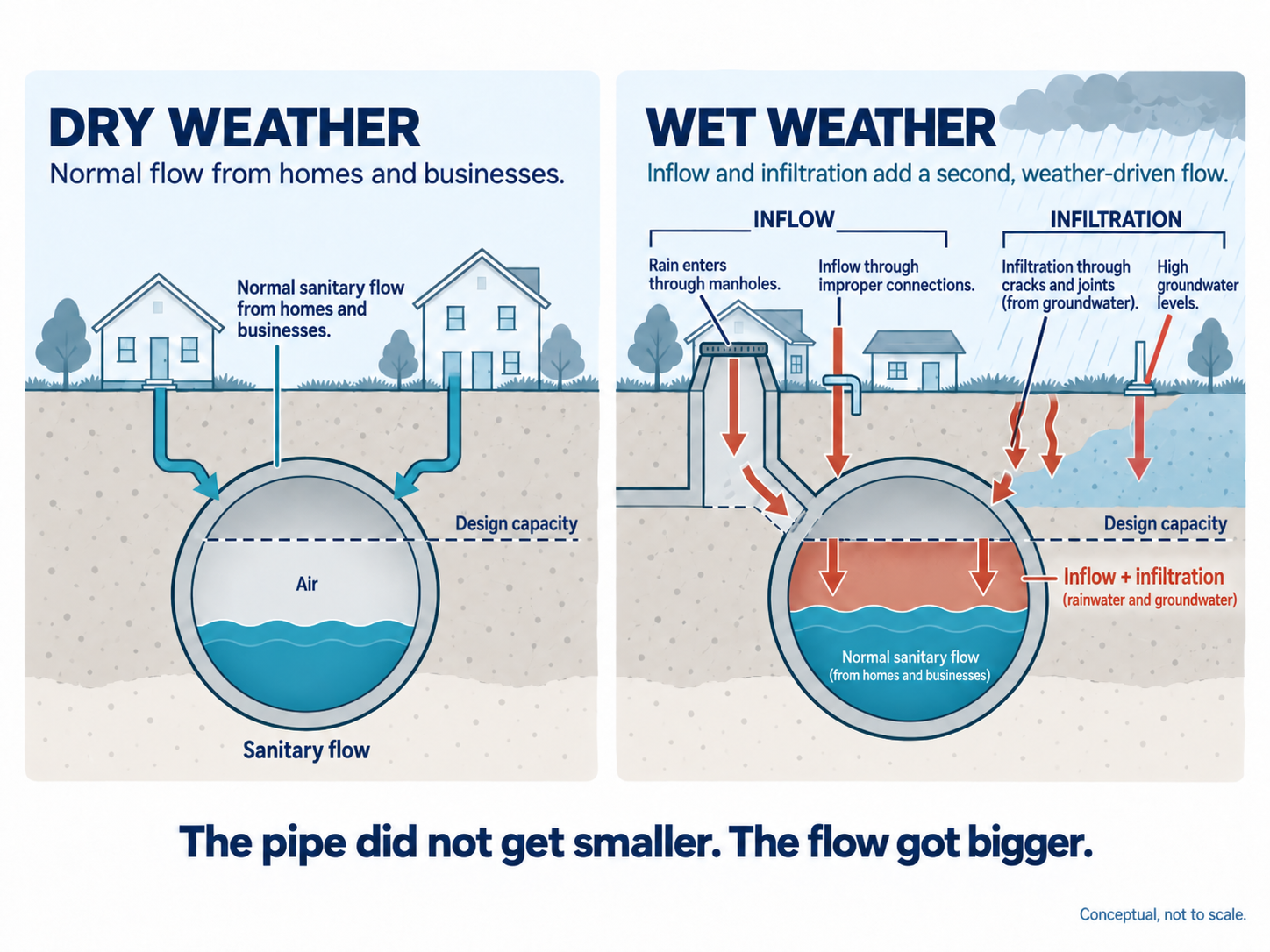
Figure 4. Conceptual, not to scale. A sanitary sewer is sized for the flow people generate, which is fairly predictable. Inflow and infiltration stack a second, weather-driven flow on top of it, and that added flow fills up the collection system long before it becomes a question about the plant.
If you read the article on why a one-hour thunderstorm can cause more flooding than a day of steady rain, this is a related story told from inside a different pipe, with one worthwhile difference. Stormwater systems care enormously about how fast rain falls. Sanitary systems care about something slightly different: how much of that rain finds a way into pipes where it does not belong.
A cloudburst can drive inflow hard, straight through open manholes and direct connections. But a three-day soaking rain, falling on ground that is already saturated with the groundwater table sitting high, can be worse for infiltration. Fast rain and long rain each find their own way in.
What actually gets done about it
This is the part that rarely makes the news, because it is slow and it looks like nothing.
Utilities run cameras through sewer lines to find cracks, offsets, roots, and grease before they cause a failure. They clean lines on a rotating schedule, prioritizing known problem segments and areas with heavy grease loading. They use smoke testing and flow monitoring to find where stormwater is entering the sanitary system, which is genuinely detective work across hundreds of miles. Then they fix what they find, increasingly by lining the existing pipe from the inside rather than digging up the street, and they build capacity where growth or hydraulics demand it.
Columbia has been doing exactly this at scale under a program called Clean Water 2020, entered into with EPA and the state, which has directed a very large amount of money into rehabilitating the collection system and reducing overflows.
That is what your sewer bill is buying. Not the flush. The flush is nearly free. You are paying for 1,100 miles of pipe, sixty pump stations, and the people who keep them from becoming your problem.
What the plant is actually trying to do
The treatment plant deserves its own article, and it will get one. But the useful thing to understand is not which process a plant uses. It is what the plant is trying to remove, because that part barely changes from city to city.
Five things, roughly in order:
Trash and grit. Everything that never should have been in there. It gets screened and settled out first, because it damages equipment.
Oxygen demand. This is the one nobody has heard of and the best answer to why any of this matters. Untreated waste released to a river gets consumed by bacteria already living in that river, and that consumption pulls dissolved oxygen out of the water. Low oxygen is what kills fish. So a plant is not only cleaning water. It is removing the appetite before the water reaches something alive.
Suspended solids. The material still floating in it.
Nutrients. Nitrogen and phosphorus. Useful on a farm, harmful in a river, where they feed algae blooms that then die and consume oxygen on their way down.
Pathogens. Disinfection at the end, before discharge.
Every one of those has a number attached to it in the plant's discharge permit, sampled and reported on a schedule. Columbia's Metro plant is a biological treatment facility rated for 60 million gallons a day. It also runs its solids through anaerobic digestion, which produces methane that the plant captures and burns to heat the digesters. The waste ends up helping treat itself.
What the list leaves out
Notice what is not on it. PFAS, the family of “forever chemicals” used in nonstick coatings, stain and water repellents, firefighting foam, and a long list of ordinary products.
A conventional wastewater plant was not designed to reliably remove or destroy PFAS, and that is not a failing of any particular plant. The heart of the process is biological. It works because microorganisms consume much of what we send them. PFAS is built around extremely strong carbon-fluorine bonds that conventional biological treatment does not readily break down. Some PFAS remain in the treated water, while others become concentrated in the solids removed during treatment.
Wastewater plants generally are not where PFAS originates. They receive it through industrial discharges, landfill leachate, and ordinary household wastewater, which is one reason source control matters so much.
Here is the framing worth keeping: a wastewater plant is not trying to produce drinking water. It is trying to hand the river back something the river can handle. For the pollutants conventional plants were built to manage, that works remarkably well. For PFAS and other highly persistent compounds, we are still working out what effective treatment and disposal should look like.
If you are not on sewer
A good share of the Midlands is not. If you are on septic, the same job is happening, just in your yard and at your expense.
Solids settle in a buried tank and are broken down biologically, and the liquid flows out to a drainfield, where it filters slowly through soil that does the rest of the treatment. The tank is the part people know about. The drainfield is the part that actually fails, usually because it got saturated, compacted, driven over, built on, or overloaded, and once soil stops accepting water there is no quick fix. Pumping the tank on a reasonable interval and keeping traffic and structures off the field is most of the maintenance there is.
The river
Follow this chain far enough and you end up in the same place the last article did. Standing beside open water.
For Columbia, treated effluent from the Metro plant goes to the Congaree River, under a permit that sets limits on what can be in it and requires continuous monitoring to prove it.
And that river keeps going. It joins the Wateree, becomes the Santee, and works its way toward the coast, passing communities that draw their own drinking water along the way. The last article ended by pointing out that if you cross the Broad River on your commute, you may be driving over your own water supply. This one ends with the other half of that thought.
Everyone is upstream of somebody.
The whole trip, collapsed
Toilet.
Trap.
Lateral.
Gravity main.
Pump station.
Force main.
Interceptor.
Treatment plant.
Congaree River.
Somebody else's source water.
The measure of a sewer system is not what it takes away. It is what it hands back to the river.
Sources
Columbia Water, About Wastewater — collection system mileage, connections served, plant location and rated capacity.
Clean Water 2020 — consent decree program scope, collection system rehabilitation, anaerobic digestion and biogas use.
City of Columbia Engineering Regulations, Table 3-1, Minimum Slope by Sewer Size — 0.40 feet per 100 feet for eight-inch sewer. Section 3.2.6.1 also requires sewers to be designed for a mean velocity of at least 2.0 feet per second when flowing full.
EPA, Per- and Polyfluoroalkyl Substances (PFAS) in Sewage Sludge — epa.gov/biosolids/and-polyfluoroalkyl-substances-pfas-sewage-sludge. EPA notes that sewage sludge may contain PFAS received from upstream dischargers including industrial facilities, landfills and homes, and recommends monitoring, identifying likely industrial sources, and pretreatment requirements where appropriate.
EPA, Sanitary Sewer Overflows and inflow and infiltration.
From the same series
← What Happens When You Turn On the Faucet? The same system, followed in the other direction.
This is the second article in a series explaining how the systems around us actually work, written for people who are not engineers.
