
What Happens When You Drive to Work?
TRANSPORTATION
Travis Basnett, PE · Licensed in SC, NC & GA · September 28, 2026 · 8-minute read
You drive the same roads every morning. Watch what changes between your driveway and the interstate, and you can see what each one was built to do.
You already know this trip. Driveway, neighborhood street, the road with the gas station on the corner, the big one with all the lights, then the interstate. An engineer sees a series of roads doing different jobs, handing you from one to the next.
A road can be built to move traffic or to provide access to property. The more it does of one, the harder the other becomes.
Most roads do some of both. The question is which job gets priority, and what the engineer changes to make that possible. Engineers call the organizing framework functional classification. The names describe a road's role in the network, and that role shapes almost everything about the pavement beneath you.
Start in your driveway
Your driveway has a very specific ambition. It wants to get you from your house to the street.
It does not need to carry strangers across town. It needs to connect one property to the network that will do that. This is access in its simplest form.
Engineers don't count it as a road class. Think of it as the connection point where the system starts: the place a private property hands you to a public network, and the last place that network hands you back at the end of the day.
Your street is doing its job
Now you are on a local street. It may not have a center line. It probably has houses on both sides, cars parked along it, and somebody walking a dog.
A local street gives you something the interstate will refuse to give you later: direct access to people's front doors. Frequent driveways and nearby intersections belong here. They are much of the reason the street exists.
That also means low speeds matter. People are backing out, crossing, and turning within a short distance of one another. Lower speeds are also what let the street work for people outside cars: a neighbor crossing to get the mail, a child on a bike.
Low speed does not remove the need to see. Backing out, you need enough view along the street to judge whether there is a usable gap. A hedge, a parked truck, or the crest of a small hill can hide exactly the stretch you need. That ability to see along the road is called sight distance, and it follows us the rest of the way.
Stopping sight distance is the distance a driver needs to recognize something ahead, react, and brake to a stop. The car keeps moving while the driver recognizes the hazard and decides to brake, and braking takes more distance after that. Both grow with speed. A slower street shortens that distance, but it never makes a blind corner acceptable.
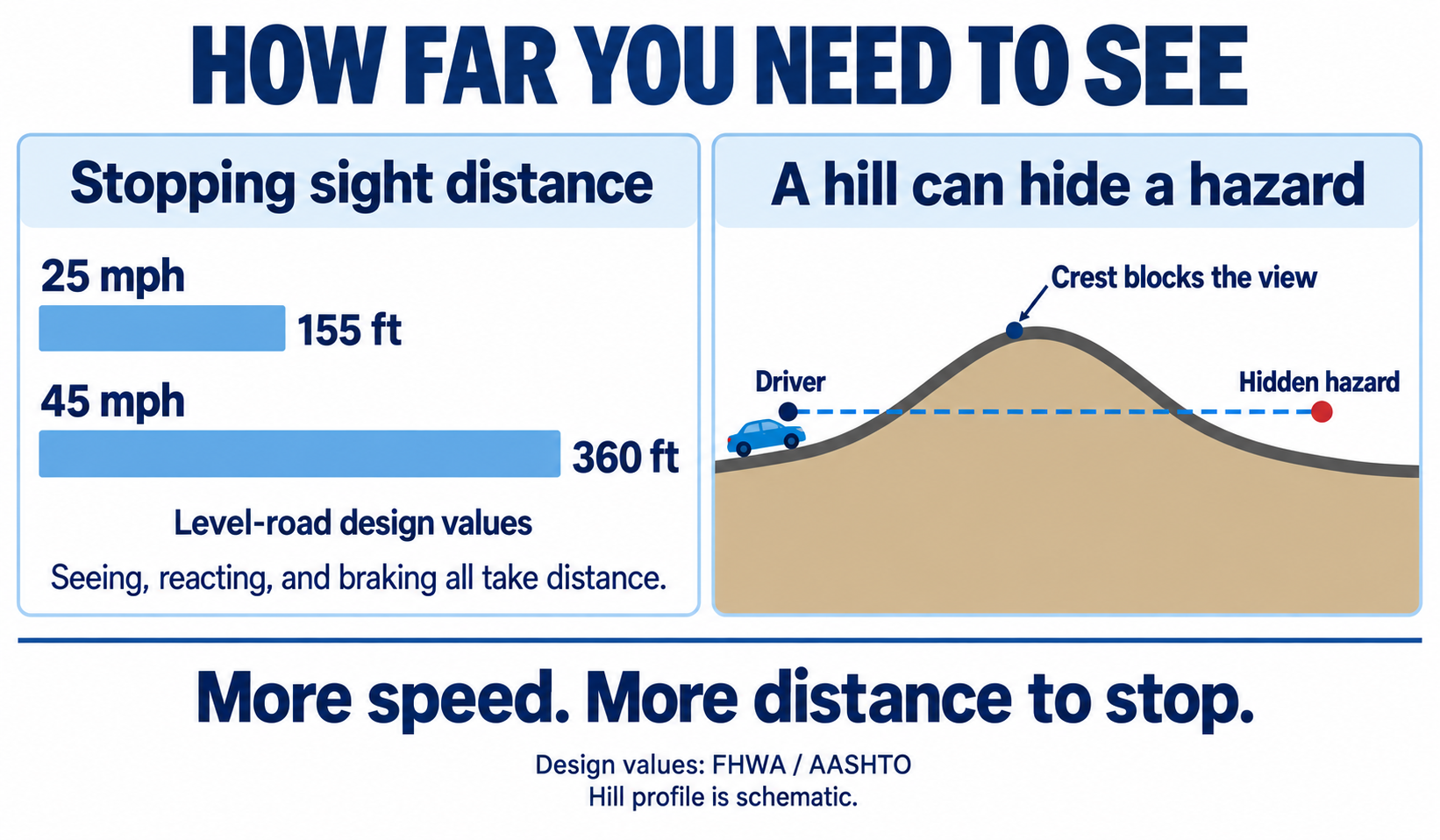
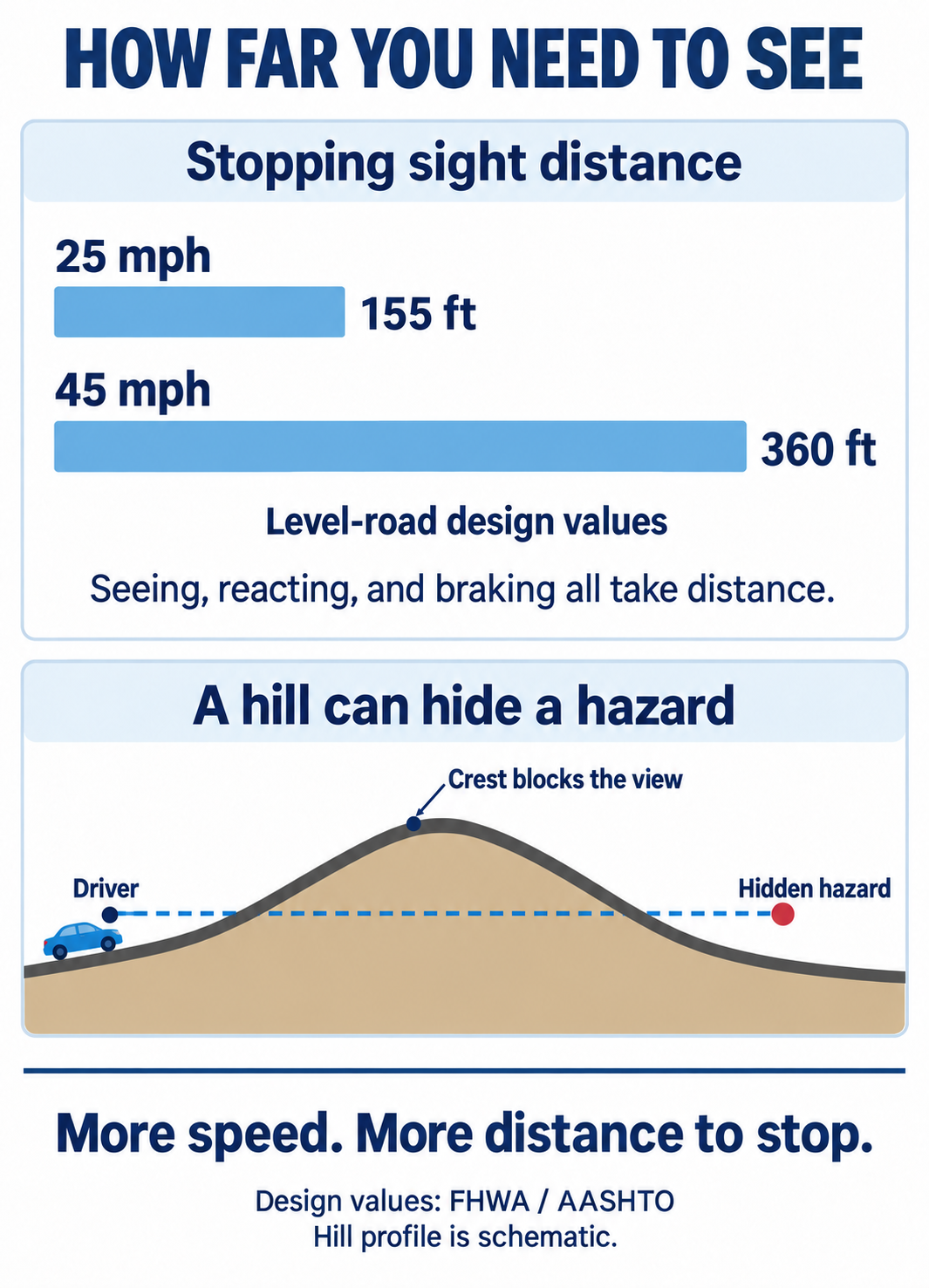
Figure 1. Stopping distance covers the ground traveled while a driver sees a hazard and reacts, plus the ground needed to brake. At 45 mph it is more than twice the distance at 25 mph. The hill profile shows how a crest hides a hazard from the driver. Distances are AASHTO design values for a level road; the hill profile is schematic.
Why does everyone speed on your street?
If you have ever watched cars fly down a street posted at 25 mph, the street itself is probably part of the reason.
When engineers lay out a road, they select a design speed. It sets features like how sharp the curves can be and how far ahead a driver needs to see. The posted speed limit is a separate decision, and the two don't always match.
Most drivers don't know either number. They drive the speed the road feels built for. A wide, straight street with long, clear views can feel comfortable at 40 mph even when the sign says 25.
That is why changing the sign alone often has limited effect. The tools that tend to work change the street itself: narrower lanes, curb extensions at corners, street trees, speed humps, a gentle bend. The Federal Highway Administration calls these self-enforcing roads, streets whose layout encourages the intended speed without relying on the sign.
Your street has the opposite job from the big road with the lights, and at low speed it does that job well. You would not want a road designed for uninterrupted cross-town travel running a few feet from your front door. You just want to be able to leave your house.
The collector gathers the neighborhood
Turn out of the neighborhood and you reach the road that gathers traffic from several local streets and carries it toward a larger road. This is a collector.
Collectors are the middle child of the system. They connect the neighborhood to the wider network while still providing access to places along the way. That school entrance or gas station driveway may be part of their everyday job too.
More drivers now share the same route, and speeds usually climb. The spacing of intersections starts to matter. Put two busy connections too close together and a driver can finish dealing with one just in time to be surprised by the other.
There is no single speed or lane width that comes with the name. A collector beside a school may need a very different design from one running through open country. The road's job guides those choices without settling them.
The arterial has to manage the interruptions
Then you reach the big road with the lights.
An arterial carries traffic across a larger part of the community. More of the people using it are trying to get somewhere beyond the next neighborhood. But the businesses along it still need customers to get in and out.
This is where the trade gets difficult.
Every driveway is effectively a tiny intersection. Somebody slows down to enter it, pulls out into traffic, or waits to turn left across the opposing lanes. Repeat that along both sides of a busy road and a lot of separate decisions end up happening in the same space.
Each entrance creates conflict points, places where traffic paths cross, merge, or diverge. Almost everything engineers do on an arterial comes down to one idea: have fewer conflict points, or spread them out so a driver deals with them one at a time.
Why you can't turn left into the shopping center
You can see the shopping center. The entrance is right there. And a raised concrete median sends you on to a U-turn or the next signal.
It feels like the road is working against you. Now picture that stretch without the median. You stop in the left lane and wait for a gap in oncoming traffic. The driver behind you brakes, and so does the one behind them. On a busy road, one waiting left turn can back up a whole lane, and impatient drivers start taking gaps that aren't really there.
Left turns across traffic are among the riskiest moves on these roads, because the turning car has to cut across oncoming lanes. The median gathers those turns at a few openings, usually with their own turn lanes, where they can be handled with less risk. You drive a little farther. The cars behind you keep moving, and far fewer paths cross.
That work is called access management, and it usually takes one of four forms.
Combine the entrances. Shared driveways, a connection between neighboring parking lots, or an entrance on a side street instead of the main road.
Space them out. Greater distance between connections gives a driver room to finish dealing with one before reaching the next.
Give turning traffic its own room. A turn lane moves a slowing or waiting vehicle out of the through lane.
Control where turns and crossings happen. A raised median limits left turns to selected openings, and signal spacing helps keep one intersection from interfering with the next.
The demand for access is still there. Access management arranges it so the road can keep moving people through.
That is why a new commercial driveway onto a busy road takes more than cutting a curb. The engineer has to consider the traffic already there, the turns the new entrance will create, and whether people can see and react in time.
People on foot are part of that math. Where there is a sidewalk, every one of those entrances crosses it, so each one is a conflict point for somebody walking as well as somebody driving. Fewer and better-organized entrances mean fewer times a person on foot has to watch for a turning car.
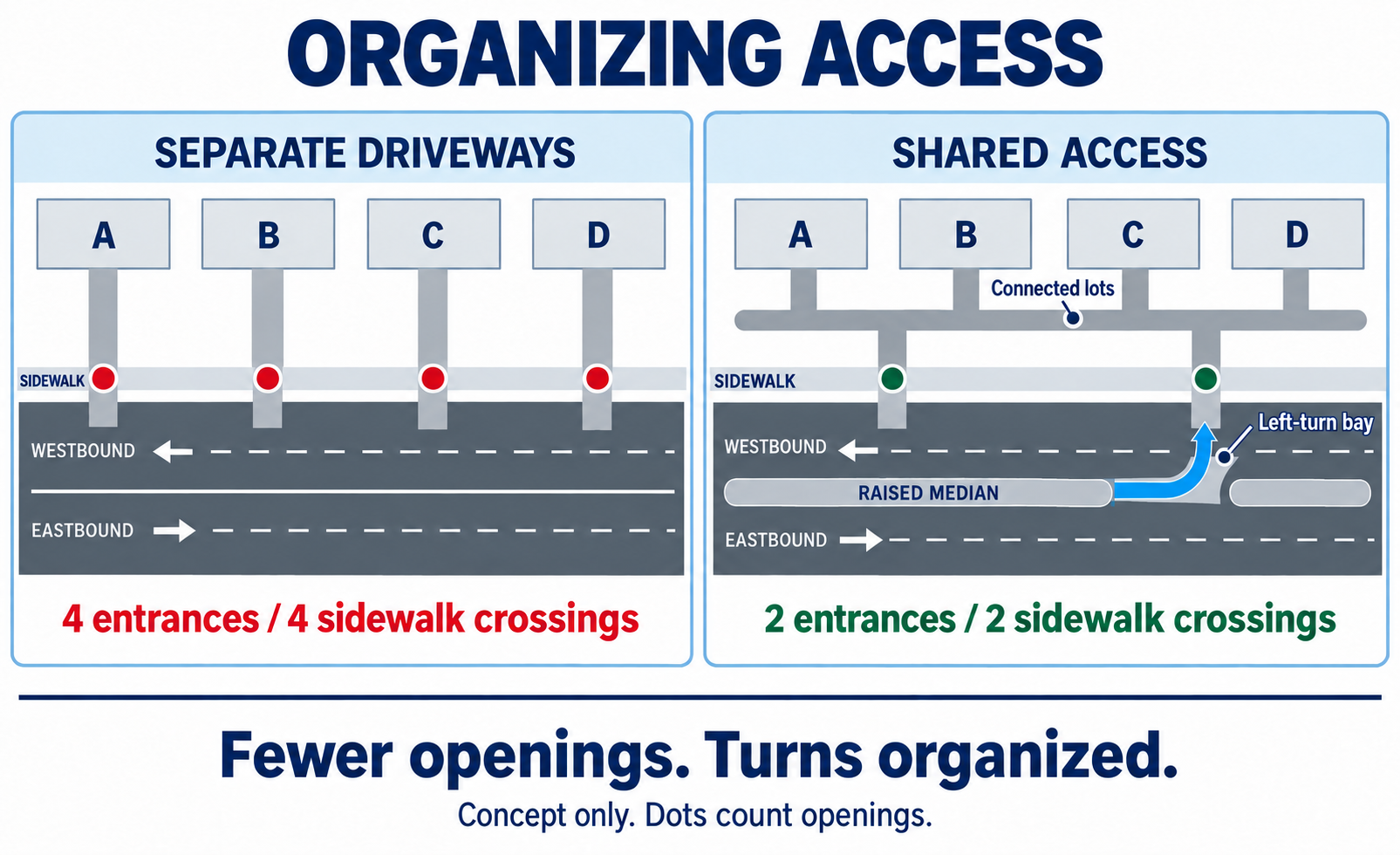
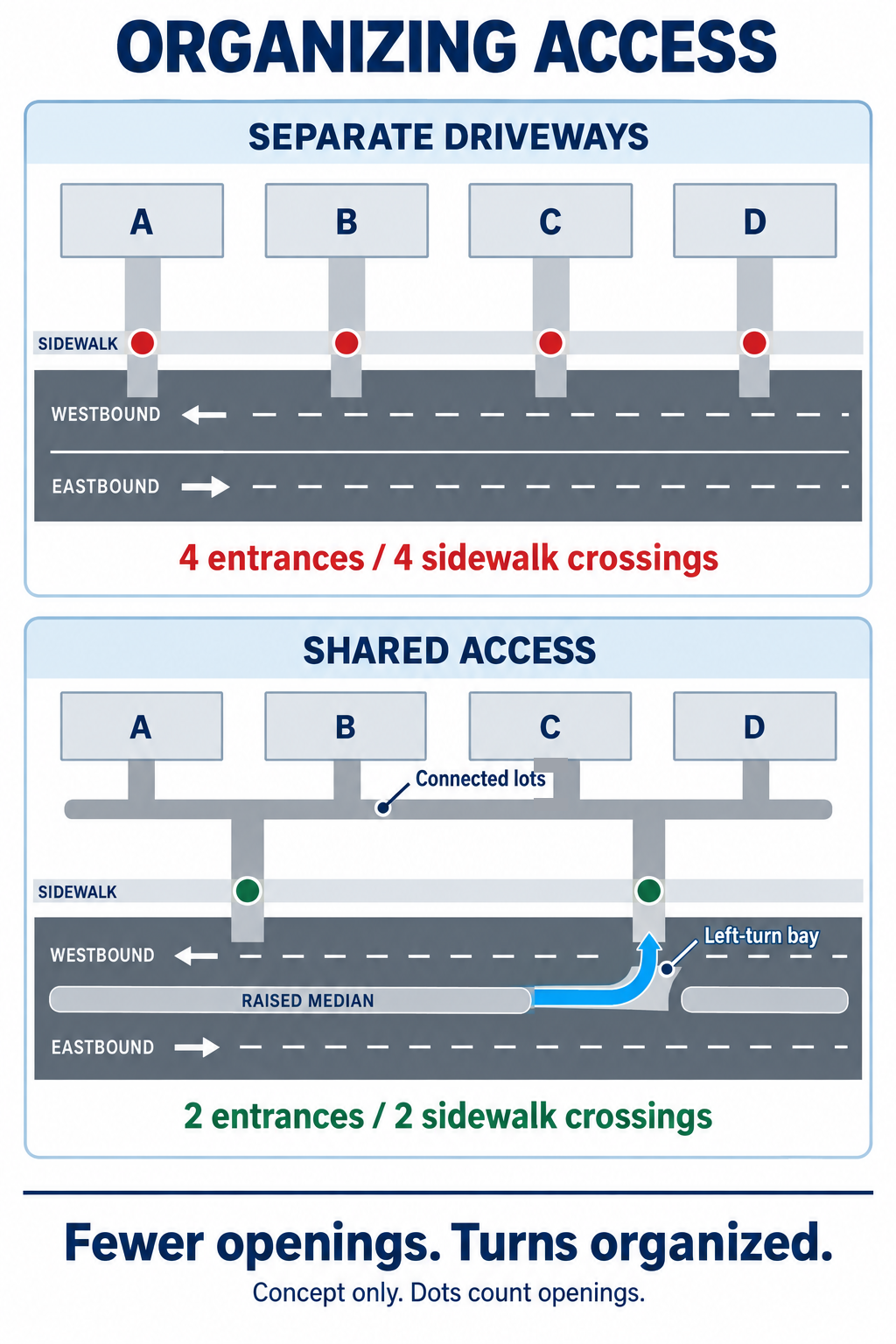
Figure 2. The same four businesses, reached two ways. Separate driveways give each business its own opening. Connected lots, two shared entrances, a raised median and a left-turn bay serve the same businesses with half the openings and half the sidewalk crossings. Conceptual layouts, not a site-specific recommendation.
Why not just add a lane?
It is the most common question about a congested road, and it deserves a real answer.
On many busy arterials, the intersections and turning movements become the real bottlenecks. An extra lane may create more room between signals, but everyone still has to pass through the same intersections. Every driveway and left turn along the road stays in place, and so do their conflicts.
A wider road has costs too. It takes longer to cross on foot, it can make higher speeds feel more comfortable, and the land usually has to come from the homes and businesses along it.
Sometimes more lanes are the right answer. Often the more useful change is organizing how people enter and leave the lanes already there: turn lanes, shared entrances, medians, and signal timing.
The interstate gives up the front doors
Finally, you reach the ramp.
An interstate is the strangest road you drive on, because it deliberately refuses to do the thing your neighborhood street does.
Nobody has a driveway on I-26. There are no storefront entrances or traffic signals on the through roadway. Every business you can see from it is reached some other way.
That is not an oversight. It is the entire design.
This is full access control. You enter and leave only at interchanges, and crossing roads pass over or under the interstate instead of meeting it at an intersection.
The same logic reaches people outside cars. Walking and biking are generally prohibited on interstates. That is the sharpest version of the trade in the whole system: the road that carries you farthest and fastest is the one part of the trip you are not allowed to walk.
The ramp changes the maneuver too. You are no longer making a sharp turn straight into fast traffic. The entrance ramp and acceleration lane give you space to build speed and merge. At an exit, the deceleration lane gives departing traffic space to slow down away from the through lanes.
Speed changes the shape of the road as well. At higher speeds, a tight bend asks more of the tires to keep the car following it, so interstate curves are long and gentle, with clear views well ahead. Many are banked slightly toward the inside to help vehicles follow the bend. A ramp can have a much tighter curve and a lower intended speed than the interstate beside it. You can feel the difference before you reach the merge.
Technically, an interstate is a kind of arterial, at the end of the spectrum that places the greatest emphasis on mobility. It gets its own section here because the physical change is so obvious. Direct property access and crossing intersections have disappeared.
Traffic still backs up, of course. What full access control removes is whole categories of interruptions that would make sustained high-speed travel incompatible with everyday use of the road.
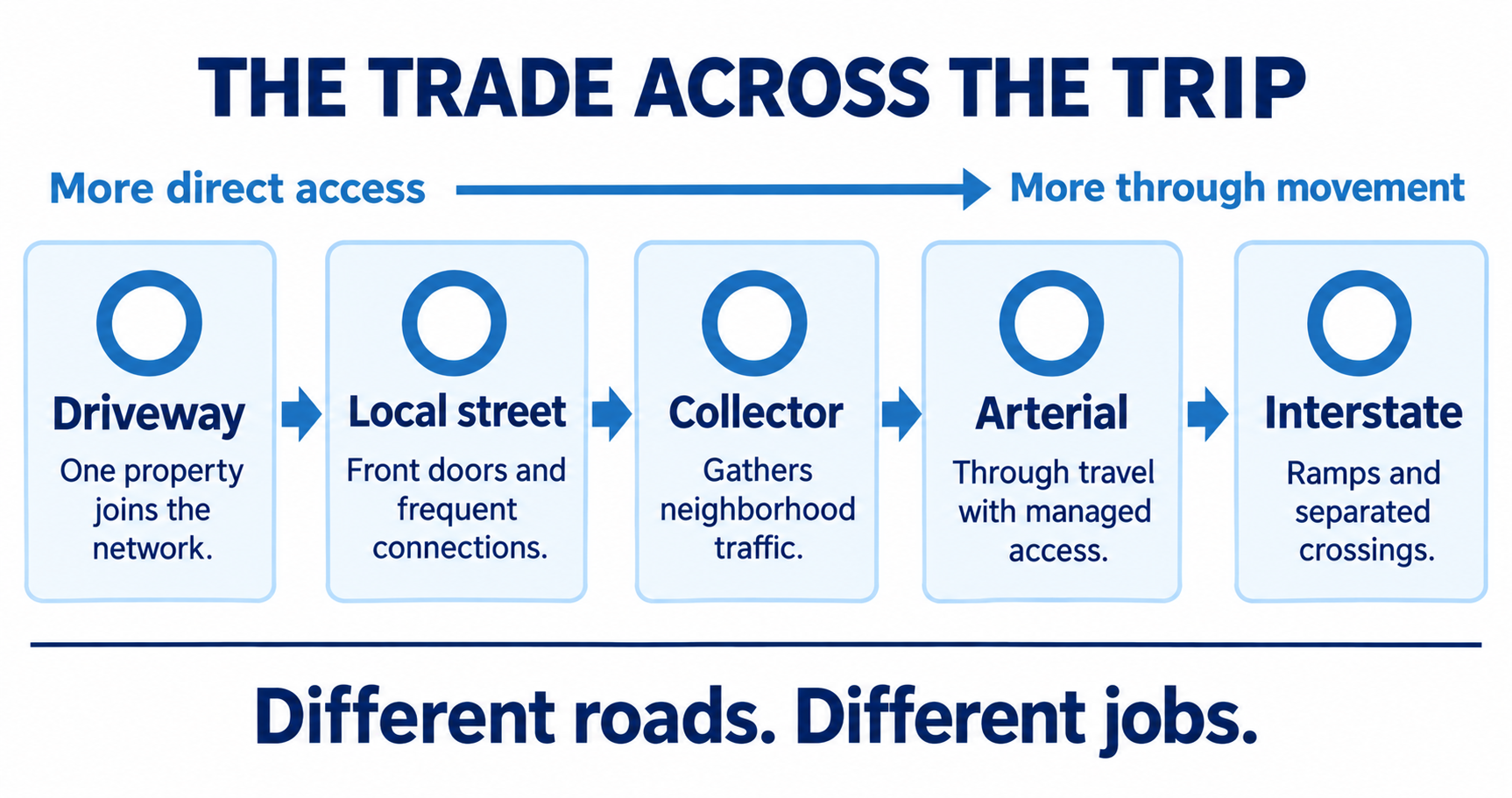
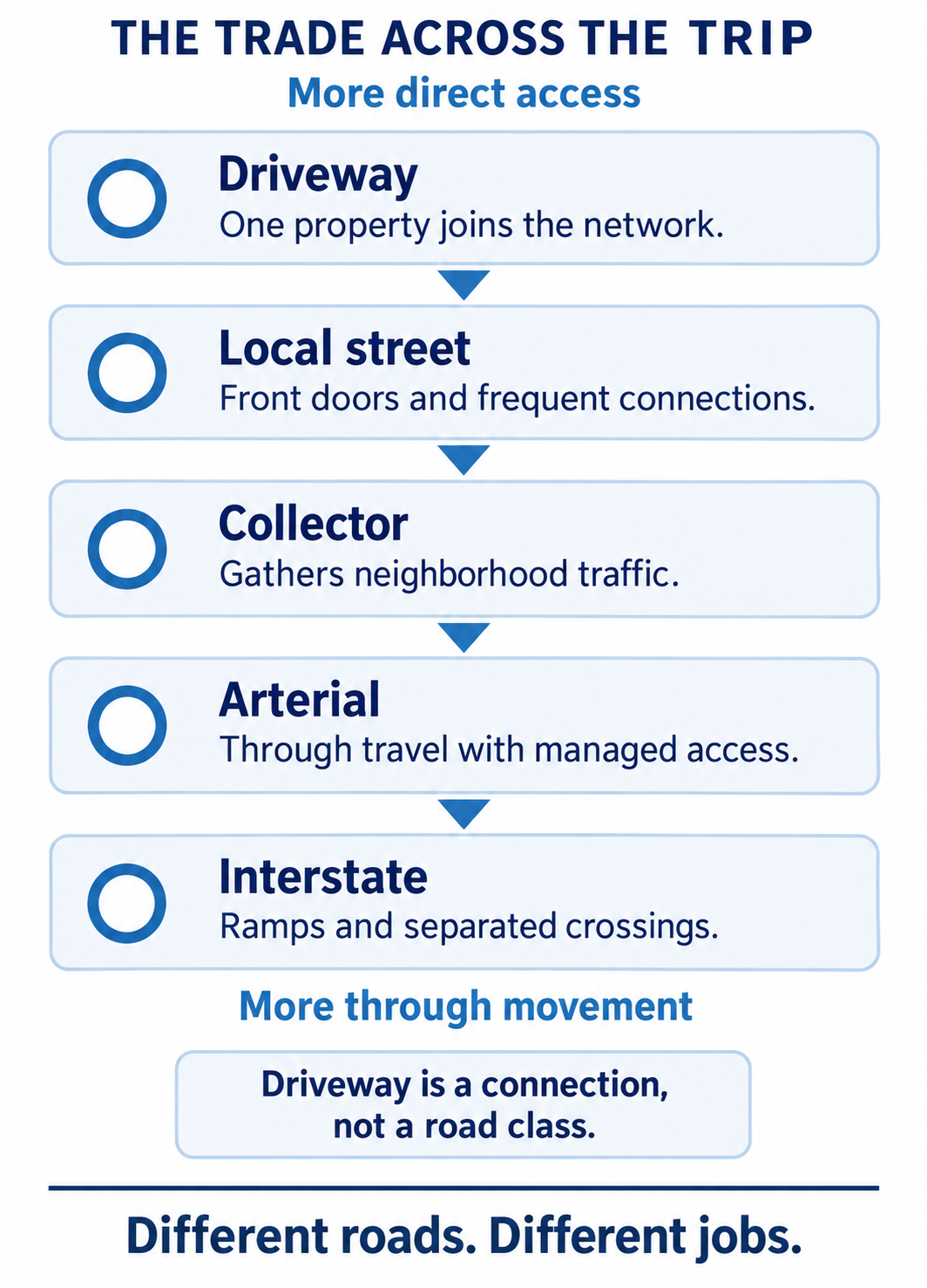
Figure 3. Each step toward the interstate trades some direct access for more through movement.
Not every commute uses every step, and not every road fits the picture neatly. Roads rarely stay what they were built to be. A country road becomes a collector when a subdivision goes in. A collector picks up a shopping center and starts acting like an arterial. Engineers adjust roads as they grow, but they are rarely rebuilt from scratch, so most carry some of their history with them.
The trade is still there, whether you notice it or not. By the time you reach the interstate, you have gained the ability to travel farther with fewer interruptions. You have given up the ability to turn directly into the places beside you. At the other end of the trip, the system has to give that access back so you can actually arrive somewhere.
The engineer's job is to make those different purposes work together. Your neighborhood should not have to behave like an interstate for the interstate to be useful. The interstate depends on the smaller roads to finish the trip.
Every road is somebody's way through and somebody else's way home.
Sources
Federal Highway Administration, Highway Functional Classification: Concepts, Criteria and Procedures, 2023 Edition: road roles and the access and mobility framework.
Federal Highway Administration, Self-Enforcing Roadways: A Guidance Report, Chapter 3: design speed, sight distance, horizontal and vertical geometry, and how road design shapes driver speed.
Federal Highway Administration, Access Management: What Is Access Management?: driveway spacing, turning lanes, medians, and signal spacing.
American Association of State Highway and Transportation Officials, A Policy on Geometric Design of Highways and Streets (the Green Book): stopping sight distance design values.
From the same series
What Happens When You Turn On the Faucet? Follow the public water system backward, from the tap to its source.
What Happens After You Flush? Follow wastewater in the other direction.
What Happens When It Rains? Where rain goes after it falls.
This article is part of a series explaining how the systems around us actually work, written for people who are not engineers.
Next: What Happens When You Drive Over a Bridge?
