
What Happens When You Turn On the Faucet?
DRINKING WATER
Travis Basnett, PE · Licensed in SC, NC & GA · September 11, 2026 · 6-minute read
A glass of tap water is the last few feet of a chain that starts in a river. Here is the whole chain, backward.
Fill a glass at your kitchen sink and ask a question you have probably never asked: where was this water before it got here?
Most of us can get as far as “the city.” A few people will say a river or lake. Almost nobody can describe what happens in between, and quite a lot happens in between. That glass of water may have started in a river or reservoir, passed through a treatment plant, traveled through miles of buried pipe, crossed a meter box in your yard, and finally moved through plumbing hidden inside your walls.
You saw none of it. You turned a handle and the water was there.
We are going to follow that trip backward, starting at the faucet and ending standing beside the water it came from.
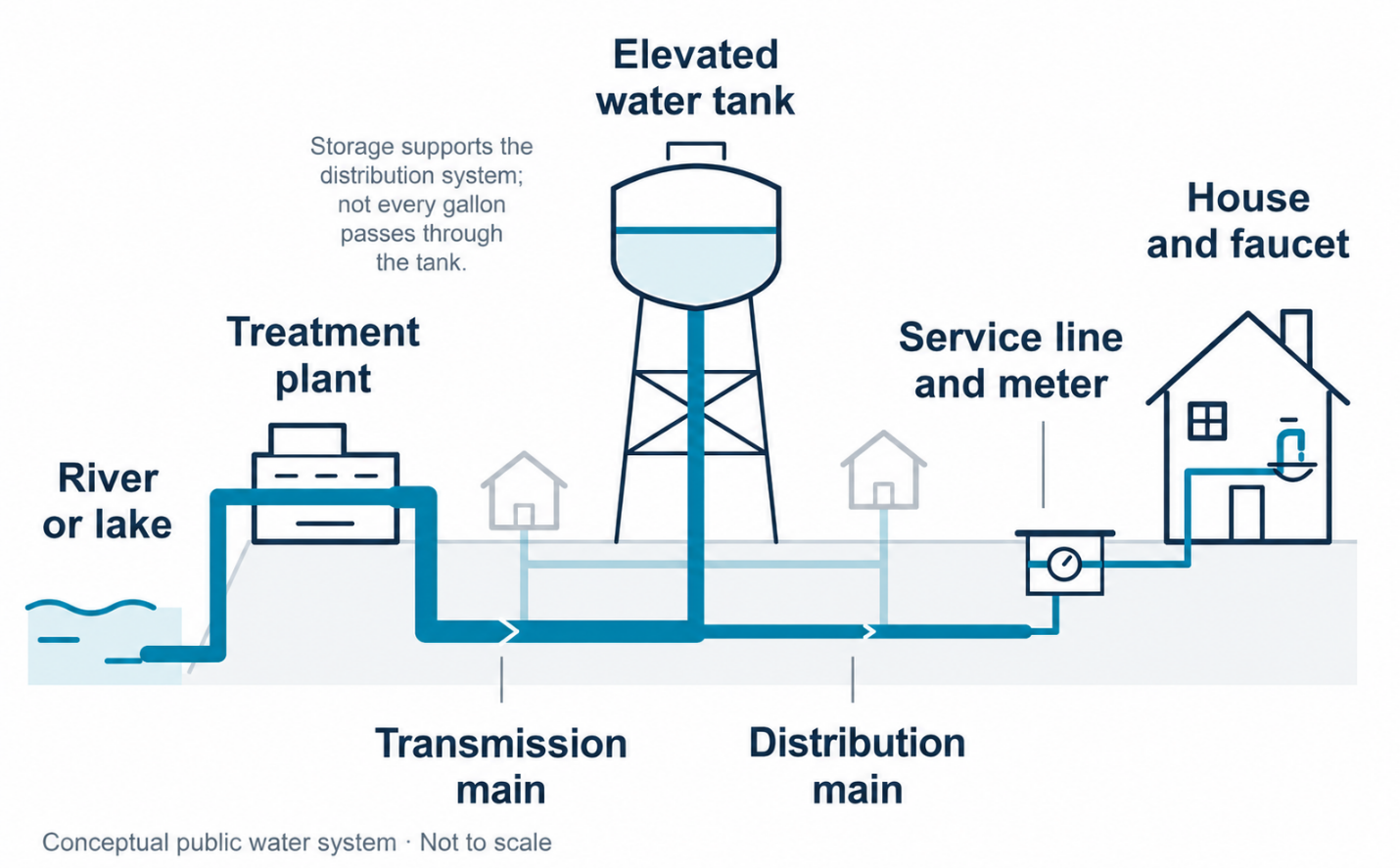
The whole chain, from source water to the tap. Water moves from larger transmission mains into smaller distribution mains on its way to individual services.
Your faucet does not go get water
Start with the strangest part, because it is the part that explains everything else.
When you open a faucet, nothing goes out looking for water. The pipe behind your wall is already full. The pipe running under your yard is already full. The pipe beneath the street is already full. All of them are under pressure, and they have been since long before you woke up.
Turning the handle does not summon water. It opens a hole. On one side of that hole is a pipe under pressure, and on the other side is your kitchen at ordinary air pressure. Water flows from the higher-pressure pipe toward the lower-pressure opening, which is why it comes out of the faucet instead of sitting in the pipe.
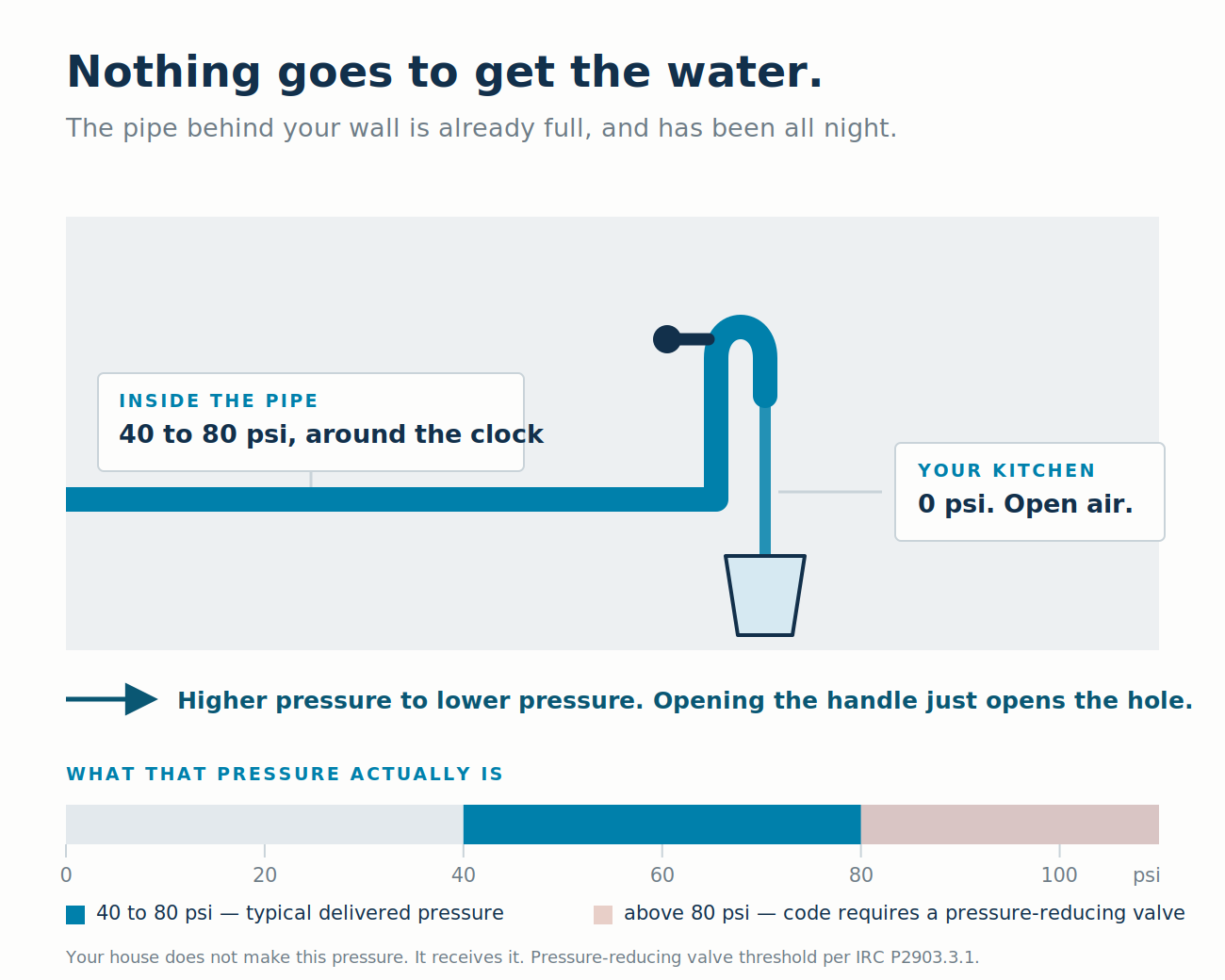
The supply pipe is already full and under pressure. Opening the tap simply connects that pressure to open air. Typical service pressure is 40 to 80 psi; above 80 psi, code requires a pressure-reducing valve.
So the remarkable thing is not that water comes out when you open the tap. The remarkable thing is that someone has kept an entire network of buried pipe full and pressurized around the clock so that it can.
That holds for the refrigerator too. Filling a bottle from the door of your fridge feels about as far from a river as you can get. The water passes through a small filter inside the appliance on its way to the dispenser, but it was already drinking water before it ever entered your house. The refrigerator is the last few feet of a system that starts many miles away.
Behind the wall
The first stretch is the part you own.
Water enters your house at one point, usually near the front or the side, and from there it splits. One branch runs to the water heater, which is why you have a hot side and a cold side at every sink. The rest fans out through progressively smaller pipes to the fixtures: kitchen, bathrooms, laundry, hose bibs, the ice maker.
This is plumbing, and plumbing is somebody else’s specialty. The only thing worth understanding here is this:
Your house does not make water pressure. It receives it.
In a typical house connected to a public water system, there is no pump pushing water to your second floor shower. The pressure at your showerhead was created somewhere else, by someone else, and your plumbing simply carries it the last hundred feet.
Across the yard
Step outside and eventually your plumbing meets the public system.
A relatively small pipe, called a service line, connects your house to the public water main. Somewhere along that connection sits a water meter, usually in a small box set flush with the ground near the street or the sidewalk. If you have ever mowed over a rectangular lid in your yard and wondered what it was, there is a good chance that was it.
Three things are happening along that connection:
The service line connects one property to a public network shared by everyone around you.
The meter measures how much water crosses into your property, which is how your bill gets calculated.
Valves along the service allow an individual property to be isolated without shutting down the entire street.
That last point matters more than it sounds. It is the reason a plumber can work on your house on a Tuesday without the block losing water.
Under the street
Here is where the system gets much bigger than most people picture.
Your service line does not run to a treatment plant. It connects to a neighborhood main, usually buried under or alongside the road. That main connects to other mains. Those connect to larger ones. Water moves from big pipes to smaller pipes as it works its way toward individual houses.
If you drew the system honestly instead of neatly, it would not look like a drinking straw running from a plant to your kitchen. It would look like a web.
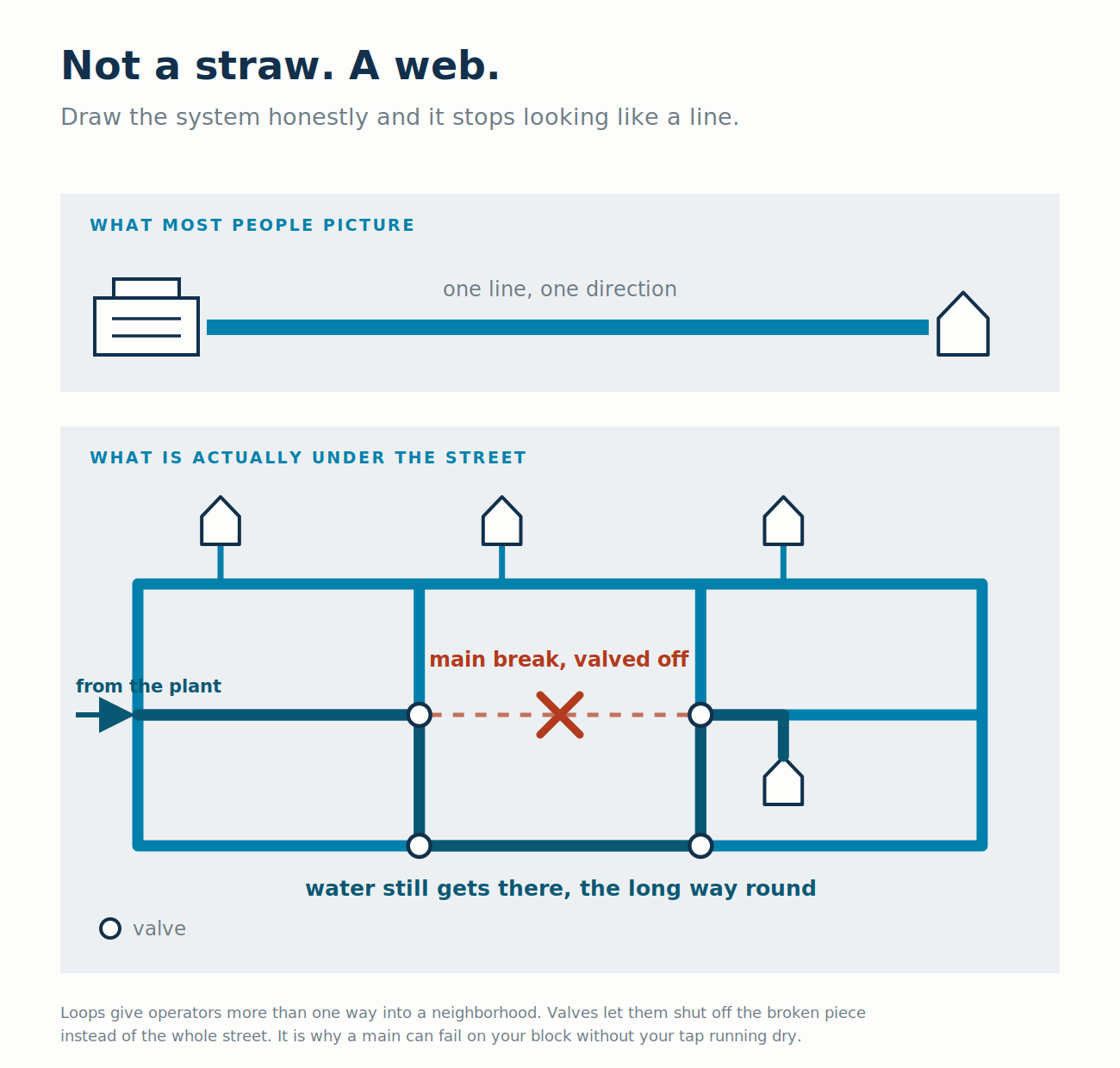
A real distribution system is looped, not linear. Valves let operators isolate a break, and the loops let water reach the houses beyond it from another direction.
That shape is deliberate. Loops can let water reach an area from more than one direction, giving operators more options when a main breaks or a section has to be taken out of service. Valves let operators isolate a damaged section and keep the rest of the system in service. Larger transmission mains carry water across town, and smaller distribution mains hand it off street by street.
In Columbia, this buried network runs to more than 2,500 miles of water line spread across nine major pressure zones, and the two treatment plants that feed it serve roughly 400,000 customers. Nearly all of it does its job quietly enough that the people driving over it never think about it.
Two things about that network usually surprise people.
The first is that it is not sized just for drinking. A kitchen faucet uses a few gallons per minute. A fire hydrant may need well over a thousand. In many neighborhoods, the pipe in your street is much larger than ordinary household demand would require because it also has to deliver water for firefighting. A few kitchens barely matter to a water main. A fire hydrant does. That is its own article, and we will get there.
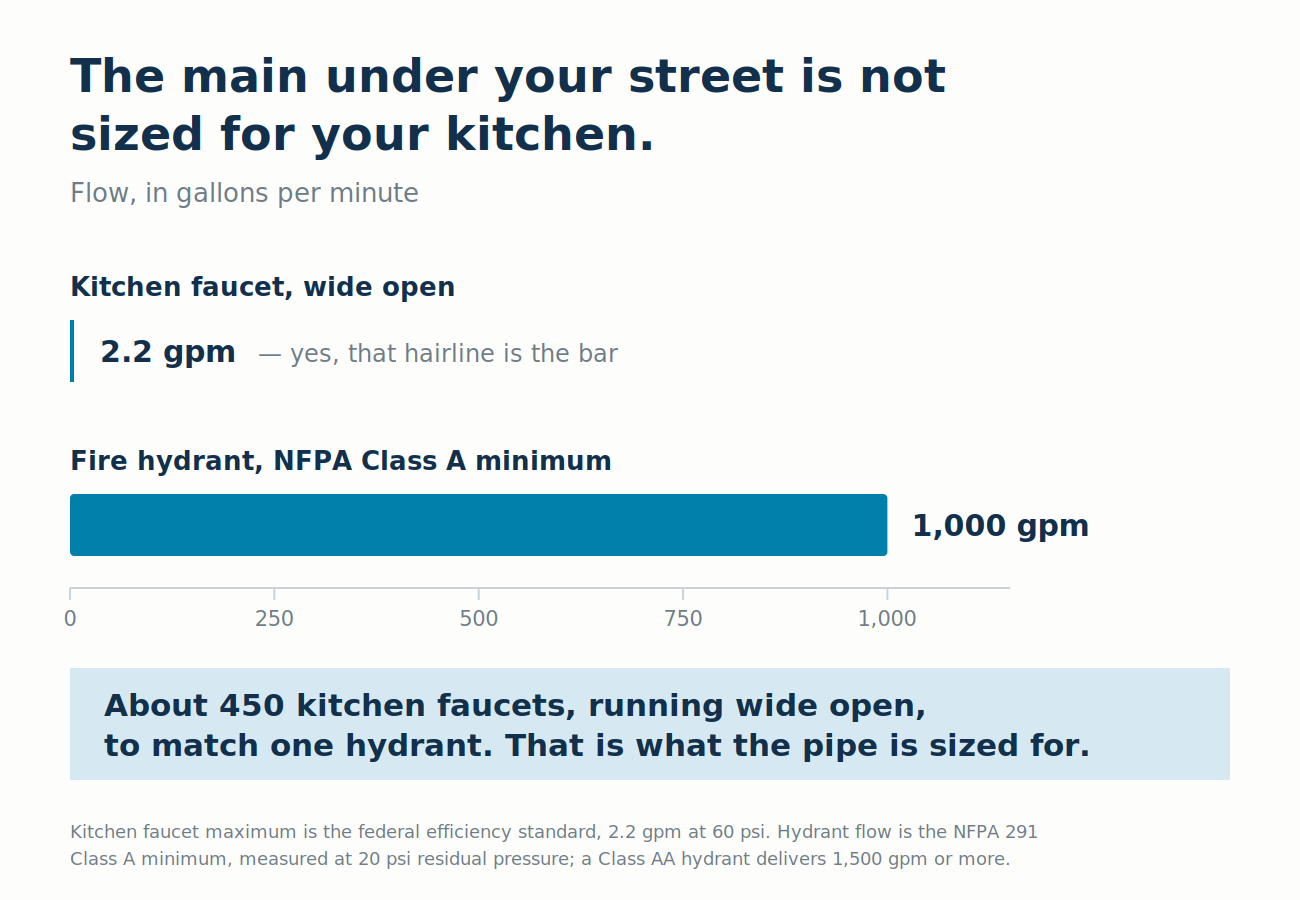
Flow, in gallons per minute. A kitchen faucet is capped at 2.2 gpm by federal standard; an NFPA Class A hydrant delivers at least 1,000 gpm. The main in your street is sized for the hydrant, not the kitchen.
The second is time. We tend to assume the water in our glass left the plant a few minutes ago. Depending on where you are in the system and how quickly water is being used, water may spend hours or even days in the distribution network before reaching a tap.
What keeps all of it moving
This is where water towers, storage tanks, pumps, and pressure zones enter the story, and this is also where I am going to stop short on purpose, because they deserve their own article.
The short version: water leaves the treatment plant and enters the distribution system under pressure. Pumps add energy. Elevated tanks, like the ones you can see from the highway, store water at elevation to help maintain pressure as demand changes and provide a reserve when something goes wrong. Booster stations add pressure where distance or elevation makes it necessary.
If you have ever wondered why water tanks are built tall instead of just being large, that is the right question to be asking. Hold onto it.
Before it entered the pipes
Back up one more step and you reach the treatment plant.
The water that entered that plant did not look like the water in your glass. Surface water carries sediment, organic material, bacteria, and a long list of other things you would not want to drink. A modern plant runs it through a sequence of processes designed to remove particles, filter what remains, and disinfect what is left before any of it is allowed into the distribution system.
A typical surface-water treatment process includes coagulation and flocculation, settling, filtration, and disinfection.
Turning river water into water you would hand to a child is the most interesting thing in this entire series, and it deserves its own trip through the plant.
The source
Follow the chain far enough backward and something changes. You stop looking at pipes and machinery, and you find yourself standing beside open water.
For Columbia Water customers, the trail ends at one of two places: Lake Murray, or the Broad River, drawn in through the Columbia Canal.
That is worth sitting with for a second. If you drive over the Broad River on your way to work and your house is served by the Canal plant, you have been crossing over your own drinking water without noticing.
And it did not start there either. That river water fell as rain somewhere upstream, on farmland and forests and rooftops and parking lots, and made its way down. Which is a different set of questions entirely, and a different part of this series.
The whole trip, collapsed
Rain.
River or reservoir.
Treatment plant.
Transmission main.
Distribution main.
Service line.
House.
Faucet.
All of that exists so that at 6:30 tomorrow morning, you can turn a handle half an inch and fill a coffee pot without thinking about a single piece of it.
A good water system turns an extraordinary amount of engineering into an entirely ordinary glass of water.
Sources
Columbia Water, About Our Services — system size, pressure zones, treatment plants, and customers served.
EPA WaterSense, kitchen faucet technical sheet — federal maximum flow rate of 2.2 gpm at 60 psi.
NFPA 291 — fire hydrant flow classes, measured at 20 psi residual pressure.
International Residential Code, Section P2903.3.1 — pressure-reducing valve required above 80 psi.
This is the first article in a series explaining how the systems around us actually work, written for people who are not engineers.
Next: What Happens After You Flush?
Curious how a system near you actually works? I write these to make everyday infrastructure legible. I also provide expert witness support and limited independent technical review for civil site, drainage, and utility infrastructure disputes.
About the Author
Travis Basnett, PE is a civil engineer with 16 years of post-degree professional experience in civil site development, stormwater design, drainage evaluation, and flooding investigations. He provides expert witness support and independent technical review for civil engineering disputes and is licensed in South Carolina, North Carolina, and Georgia.
Disclaimer: This article is intended for general informational purposes and does not constitute legal or engineering advice regarding any specific property, project, or water system.
