
What Infrastructure Does a Data Center Actually Use?
DATA CENTERS
Travis Basnett, PE · Licensed in SC, NC & GA · 11-minute read
Data centers are usually discussed as if they all demand the same things from the communities around them. They do not.
A data center is a strange kind of development.
It can cover hundreds of acres and contain buildings the size of warehouses, but generate surprisingly little traffic once construction is finished. It may need a water line sized for fire protection even if it barely uses drinking water day to day. It can consume more electricity than an entire town while sending relatively little wastewater back to the sewer system.
And two projects that look almost identical from the road can have completely different infrastructure demands because of a decision made deep inside the mechanical design.
Recent South Carolina proposals have brought these questions into public view. I am not advocating for or against building data centers; I want to explain their infrastructure requirements from the engineering side.
Electricity is fundamental to what a data center does. Water use depends heavily on how the facility is designed.
The useful engineering question is:
What does one actually need from the infrastructure around it?
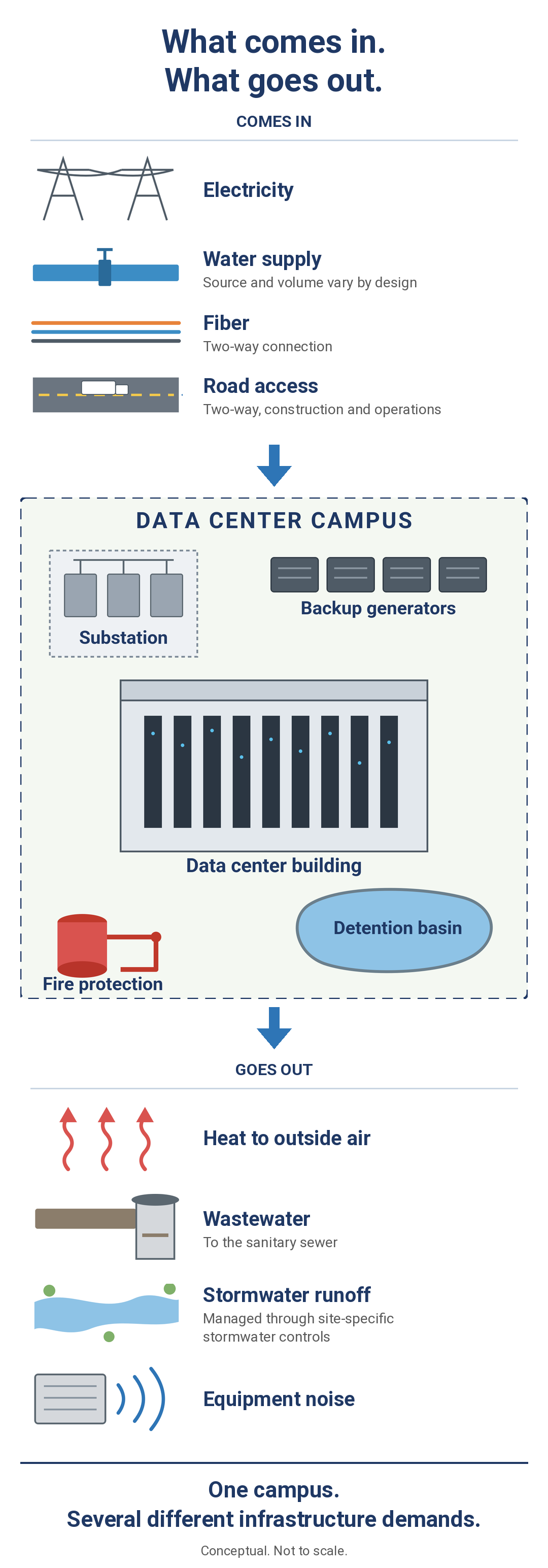
Figure 1. Conceptual infrastructure boundary of a data center. The facility receives power, connectivity, water and physical access while rejecting heat and creating site-specific wastewater, stormwater and noise impacts. The size of each demand depends heavily on how the campus is designed.
Start with the one thing it cannot avoid
A data center is, at its core, a building full of computers. Computers use electricity. Almost all of that electricity eventually becomes heat. Everything else begins there.
In its 2025 update, released in June 2026, Lawrence Berkeley National Laboratory estimated that data centers used about 192 terawatt-hours in 2024, roughly 4.7 percent of U.S. electricity. Its reference case projects about 11.8 percent by 2030, within a range of roughly 9.5 to 15.3 percent. These are estimates and projections, not a measurement of today’s demand.
Globally, the International Energy Agency's 2025 Energy and AI report projected that data-center electricity consumption would more than double by 2030.
A data center does not spread its demand across thousands of houses. It concentrates it in one place.
Homes create peaks and valleys as people cook dinner and run air conditioners. Data-center servers, networks and cooling operate around the clock, often creating a flatter demand profile.
Engineers describe this using load factor, average demand divided by peak demand over the same period. A load that stays close to its peak has a high load factor.
100 MW of peak demand and 100 MW of nearly continuous demand are very different things to a utility.
A large campus may require its own substation, new transmission infrastructure, large transformers and redundant electrical feeds. Utility upgrades and major equipment can take longer to deliver than the buildings they serve.
Some developers are not waiting. A growing number of campuses plan to generate their own power on site, usually with natural gas turbines or engines, either permanently or as bridge power until a utility connection is ready. One 2026 industry tracker counted about 90 gigawatts of these plans, though only about 2 gigawatts were operating by mid-2026.
Onsite generation can reduce or delay the need for new transmission lines. It does not remove the infrastructure question. It shifts it toward gas pipelines, air permits, fuel supply and noise at the property line.
Who pays for utility upgrades, and how those costs affect other customers’ bills, are rate and cost-allocation questions alongside the engineering.
An announced full-buildout capacity is also not necessarily the opening-day demand. Campuses can grow in phases over years. Nameplate capacity, actual peak demand and average operating demand need to be distinguished.
A data center can use electricity more efficiently. It cannot stop needing electricity.
Then all of that electricity becomes heat
If you put a megawatt of electrical power into servers, most of that energy eventually has to leave the building as heat. How do you get rid of it?
This is where the water discussion begins.
For years, one common answer has been evaporative cooling. In a cooling tower, warm water is exposed to moving air and a small portion evaporates. That evaporation carries heat away. The remaining water circulates again.
Recirculating water does not necessarily mean non-consumptive water use.
A cooling tower recirculates water. It also intentionally evaporates some of it. Makeup water replaces evaporation and the water periodically discharged as blowdown to control dissolved minerals.
But cooling does not have to work that way
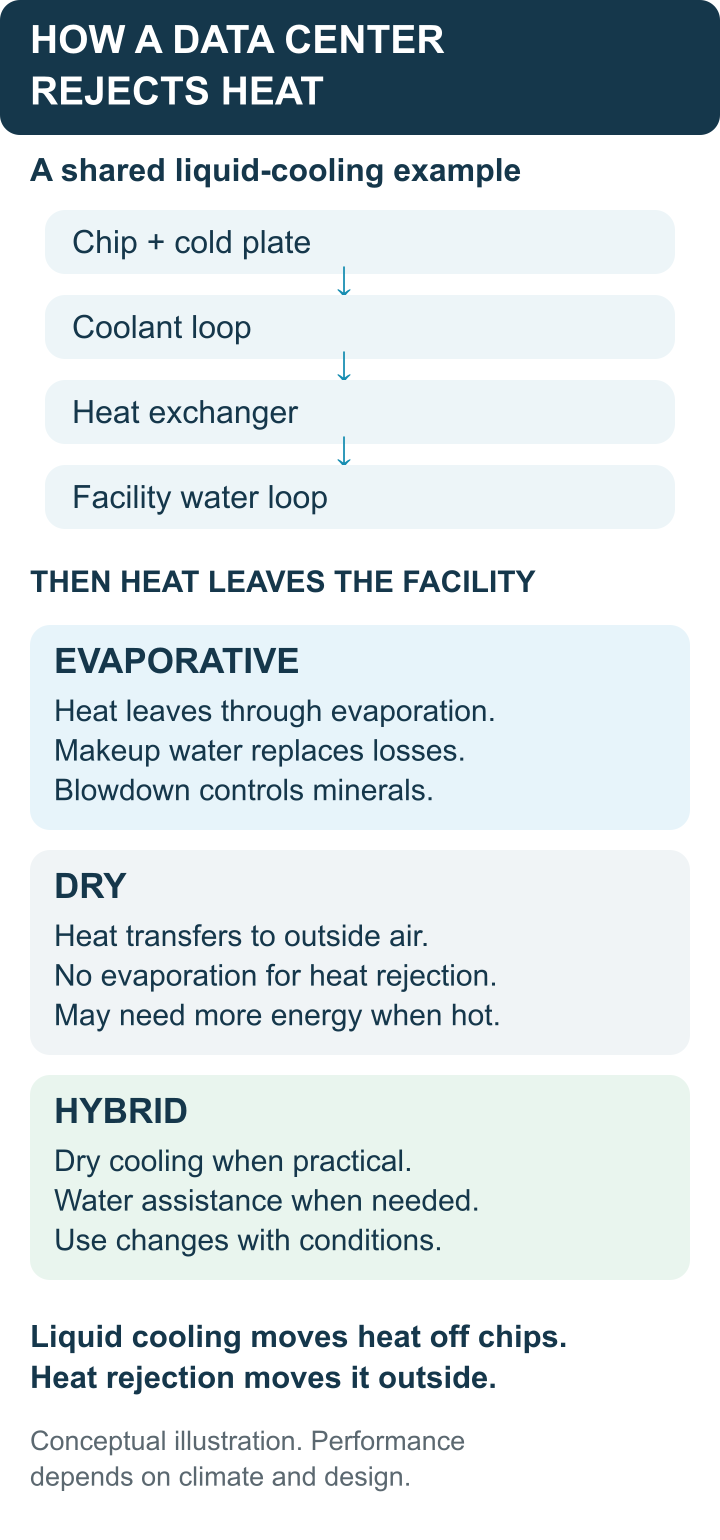
There are several ways to reject heat. Evaporative systems use water to improve heat rejection. Dry systems transfer heat to outside air without evaporating cooling water. Hybrid systems use dry cooling when practical and water when conditions justify it.
Dry cooling can require more electrical energy, particularly in hot conditions, but the comparison depends on climate, operating temperatures and equipment design.
Increasingly, high-density computing equipment is cooled directly with liquid. Coolant can circulate through cold plates attached to processors, carry heat through a heat exchanger and return to the servers. That internal loop can be essentially closed.
But even then, the heat still has to go somewhere. The facility can reject it through a cooling tower, a dry cooler, an air-cooled chiller or a combination of systems.
Liquid cooling describes how heat leaves the processors. Dry or evaporative cooling describes how that heat ultimately leaves the facility.
Figure 2. Three approaches to rejecting heat. Evaporative systems use water to improve heat rejection; dry systems reject heat without evaporation; hybrid systems combine both. Energy and water performance depend on climate and design. A closed processor-cooling loop does not, by itself, identify the final heat-rejection method.
Microsoft's December 2024 design announcement describes closed-loop chip-level cooling with no water evaporation during normal cooling operation. The company said these designs involve a modest energy trade-off and that new sites would begin coming online in late 2027.
Amazon describes another approach: outside-air cooling for about 90 percent of operating time across the facilities it describes, with evaporative cooling during hotter conditions. That portfolio statement is not a guarantee for an individual site.
You cannot determine a data center's water demand from its size alone. You have to know how it rejects heat.
Two numbers you will hear
Two industry metrics, used in DOE’s design guide, compare total facility energy with IT-equipment energy (PUE), and site water use with IT-equipment energy (WUE). Neither replaces the actual power and water demands a utility must plan for.
Water has another question attached to it
Even knowing how much water a facility uses is not enough. You also need to know what kind of water.
A cooling system might use potable water from a public utility, reclaimed wastewater, raw surface water or groundwater. A dry system may use very little water for heat rejection.
A million gallons per day of drinking water supplied by a small rural utility creates a different planning problem from the same volume of reclaimed wastewater. Reclaimed water can reduce potable demand, but its availability, treatment needs and effect on downstream return flows still matter.
Engineers also distinguish withdrawal from consumption. Withdrawn water may later return through the sewer system and treatment plant. Water evaporated from a cooling tower is consumed at the site; it does not return through the wastewater system.
South Carolina examples
Google’s Berkeley County facility shows why the water source matters. In 2019, Google requested permission to withdraw up to about 1.5 million gallons of groundwater per day. A December 2019 agreement, described by the Southern Environmental Law Center, limited groundwater withdrawals to last-resort backup use, with an exception for well maintenance. A 2024 report described groundwater use in the reported period as a small fraction of the permitted amount, with most water supplied by the local utility. That historical reporting does not establish present-day operating demand. A permit limit, a backup source and actual daily use are three different numbers.
In Colleton County, the October 2026 settlement, as announced by a party to the agreement, calls for a data center exclusion area that includes the developer’s original roughly 850-acre site near the Ashepoo River. The same developer has also proposed a larger campus elsewhere in the county that it says would use closed-loop, non-evaporative cooling. Water estimates for the first site would not describe the second. Each proposal has to be evaluated on its own cooling design, water source and utility demands.
Water in does not equal wastewater out
For a house, much of the metered water leaves through the sanitary sewer, as described in What Happens After You Flush?
A data center can behave very differently. If water is used primarily for evaporative cooling, a substantial share leaves through the atmosphere instead.
The wastewater system may receive cooling-system blowdown, domestic wastewater from employees and certain process flows. It does not necessarily receive anything close to total water demand. Blowdown quality, treatment chemicals and the receiving utility's discharge requirements also need review.
A dry-cooled facility may have both low water demand and little wastewater. An evaporatively cooled facility may have high water demand but return only part of it to the sewer.
Water demand and wastewater demand are not mirror images.
Stormwater is more familiar
From a civil engineering standpoint, this part looks more like any other large development. Data centers create roof areas, equipment yards, access roads, substations and other impervious surfaces.
Rain cannot soak into those surfaces as it did into the undeveloped ground. That means evaluating detention, conveyance, erosion control and water-quality treatment.
But the impact is site-specific. A development on sandy soil in flat terrain is not the same hydraulic problem as one on steep clay soils draining toward an already constrained creek. Roof runoff and runoff from trafficked pavement or equipment yards can also have different pollutant concerns.
The questions are familiar: Where does the water go? How fast does it get there? What was the site doing before development? And what is downstream?
What Happens When It Rains? follows the drainage path. If the Detention Pond Meets the Rules, Why Is My Neighborhood Still Flooding? explains the downstream question.
The noise is usually outside the server room
The computers themselves are not usually what a neighboring property hears. The exterior equipment can be: fans, air-cooled chillers, cooling towers, transformers and standby generators.
Onsite power plants add another source. Gas turbines and large engines can run around the clock and be heard well beyond the property line. Near Memphis, residents filed a lawsuit in 2026 over noise from turbines powering a data center. Some local approvals now set decibel limits at the property line.
Setbacks, buildings, quieter fans, acoustic barriers, generator enclosures and testing schedules can reduce disturbance.
The actual equipment, sound frequencies, nighttime conditions and nearby receptors matter. The same sound beside an interstate highway and beside a rural house can be experienced very differently.
Construction traffic and operating traffic are two different things
Construction brings trucks, cranes, heavy equipment and workers onto the road network. What Happens When You Drive to Work? explains how access and through movement affect that network.
Once the facility is operating, the picture changes. Thousands of servers do not require thousands of employees. Operational traffic can be relatively modest compared with other developments of similar acreage, although staffing, deliveries and maintenance still need to be counted.
High construction traffic does not necessarily mean high permanent traffic.
Then there is the infrastructure you rarely see
A data center without connectivity is just an expensive building full of warm computers. It needs fiber, and often more than one connection.
Facilities designed around reliability seek physically diverse routes so that one cut cable does not isolate the site. Two connections in the same trench may not provide that protection.
Redundant power, network paths and cooling aim to keep a single failure from shutting everything down. The requirements depend on the facility.
A small daily water demand can still require a big water main
There is another water demand that has nothing to do with cooling: fire protection.
A facility may use little potable water during normal operation but still require substantial fire flow. The main, storage and pumping requirements may therefore be controlled by emergency demand rather than daily consumption.
That should sound familiar from What Happens When You Turn On the Faucet?.
Sometimes the biggest water demand a building has is one everyone hopes it never uses.
Backup power brings its own infrastructure
If the grid fails, servers cannot simply wait for power to return. Standby generation, batteries and other backup systems bridge that interruption in different ways.
They introduce their own questions. Where is fuel stored? How frequently are generators tested? What noise and emissions do they create? What containment is needed? How long can the site operate without grid power?
These are real impacts, but they are different from normal electrical demand.
There is no standard data center
Cooling determines much of the water and wastewater demand. The site controls stormwater impacts. Equipment and layout affect noise, while traffic changes between construction and operation.
Some data centers consume enormous amounts of water. Some modern designs consume very little water for cooling. The mistake is assuming either describes every project.
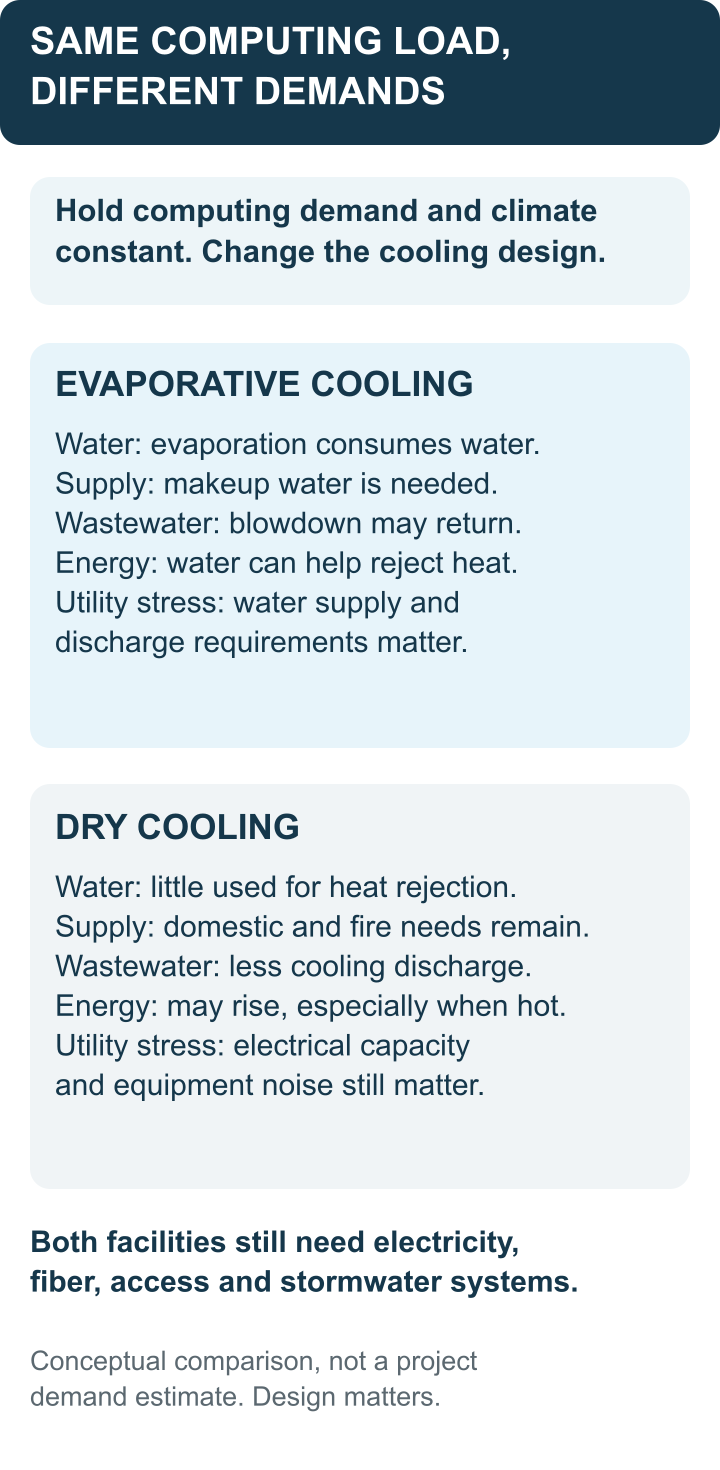
Figure 3. Hold computing demand and climate constant, then change the cooling design. Two facilities can perform essentially the same function inside the building while asking different things from the infrastructure outside it. This conceptual comparison is not a project demand estimate.
The questions are better than the label
The more useful questions are:
What are opening and full-buildout electrical demands, including average and peak loads?
Which power-system upgrades are needed, and when?
How will the facility cool equipment and reject heat?
What are annual, maximum-day and peak water demands?
What is the water source and plan for drought or extreme heat?
How much wastewater returns, and what is in it?
Where will runoff go, and what is downstream?
What produces noise at night and during generator testing?
What fire flow, storage and pressure are required?
How do construction and operating traffic differ?
What fiber and utility redundancy does the site require?
Those are engineering questions. They can be investigated with project-specific information.
“Data center” describes what happens inside the building. It does not tell you what the building asks from everything around it.
Sources
Lawrence Berkeley National Laboratory, United States Data Center Energy Usage Report: 2025 Update (June 2026): 2024 electricity estimates and 2030 projections.
International Energy Agency, Energy and AI (2025): global electricity-demand projection.
Cleanview, Bypassing the Grid: How Data Center Developers Are Building Their Own Power Plants (2026): onsite generation plans and operating capacity.
U.S. Department of Energy, Best Practices Guide for Energy-Efficient Data Center Design (2024): cooling configurations, PUE and WUE.
U.S. Department of Energy, Cooling Water Efficiency Opportunities for Federal Data Centers: cooling-tower water efficiency.
Microsoft, Next-generation datacenters consume zero water for cooling (December 2024): company-described design and anticipated rollout.
Amazon, How Amazon is making its data centers more water-efficient: company-described outside-air and evaporative cooling approach.
Google, South Carolina Water Fact Sheet (June 2019): Berkeley County groundwater permit request. See also SELC’s December 16, 2019 agreement announcement for the withdrawal restrictions described by a party to the agreement.
The Post and Courier, An unquenchable thirst? Why Google can’t endlessly recycle water for its cooling centers (2024): Berkeley County water sources and reported groundwater use.
Southern Environmental Law Center, Colleton County settlement announcement (October 5, 2026): a settlement party’s description of the agreed exclusion area.
Live 5 News, New proposed Colleton County data center campus draws residents’ questions (September 2026): developer-described cooling, power and noise plans.
WPLN/NPR report on a 2026 lawsuit over data center turbine noise near Memphis (September 2026): onsite generation noise.
Cover photo: Google data center, Council Bluffs, Iowa, photographed February 18, 2017. “Data Center” © 2019 Chad Davis, sourced from Flickr via Wikimedia Commons, used under CC BY 2.0. The thumbnail may be cropped for display.
From the same series
This article is part of a series explaining how the systems around us actually work, written for people who are not engineers.
Coming in the series: What Happens Before a New Neighborhood Is Built?
Curious how a system near you actually works? I write these to make everyday infrastructure legible. I also provide expert witness support and limited independent technical review for civil site, drainage and utility infrastructure disputes.
About the Author
Travis Basnett, PE is a civil engineer with 16 years of post-degree professional experience in civil site development, stormwater design, drainage evaluation and flooding investigations. He provides expert witness support and independent technical review for civil engineering disputes and is licensed in South Carolina, North Carolina and Georgia.
Disclaimer: This article is intended for general informational purposes and does not constitute legal or engineering advice regarding any specific property, project or utility system.
Graphics note: The diagrams in this article were created with AI assistance and reviewed by the author. They are simplified and not to scale. The cover photograph is credited separately.
