
ELECTRIC POWER
Travis Basnett, PE · Licensed in SC, NC & GA · 12-minute read
The lights flicker during a thunderstorm, then everything goes dark. Why does it happen, why does your neighbor still have power, and what actually takes place before the lights come back on?
You're sitting in your living room when a thunderstorm rolls through.
The rain picks up. Wind pushes against the windows. Somewhere in the distance, you hear a crack of thunder.
Then the lights flicker.
Your television shuts off and immediately comes back on. A few seconds later, the lights blink again. Everything seems fine until, without warning, the entire house goes dark.
You look out the window. The streetlights are out, but your neighbor across the street still has power.
You check your phone. The electric company knows about the outage, but there's no estimated restoration time.
What just happened? Why did the power come back twice before going out completely? Why does your neighbor still have electricity? And why might it take hours to fix something that happened in a fraction of a second?
To answer those questions, we need to follow the wires.
The last few feet
Start at your house.
Electricity enters most American homes through a service connection, either from wires overhead or a cable buried underground. That connection leads to your electric meter and then to the electrical panel that distributes power throughout your house.
But the electricity arriving from the utility doesn't start at the voltage your appliances use.
Somewhere nearby is a transformer. In older neighborhoods with overhead utilities, you've probably seen one without knowing what it was: a gray metal cylinder mounted near the top of a wooden utility pole.
In newer neighborhoods with underground utilities, it's often a green metal box sitting beside the street or near someone's property line.
Both perform essentially the same job.
The utility's distribution lines carry electricity at thousands of volts. The transformer reduces that voltage to the familiar 120/240-volt service used by most American homes.
A single transformer may serve several houses. Others serve only one customer.
That detail matters.
If your house loses power because the transformer serving it fails, the outage might affect only you and a handful of neighbors. The rest of the street could be operating normally.
But if the failure occurs farther upstream, the outage could affect hundreds or thousands of customers.
The location of the failure determines how far the consequences spread.
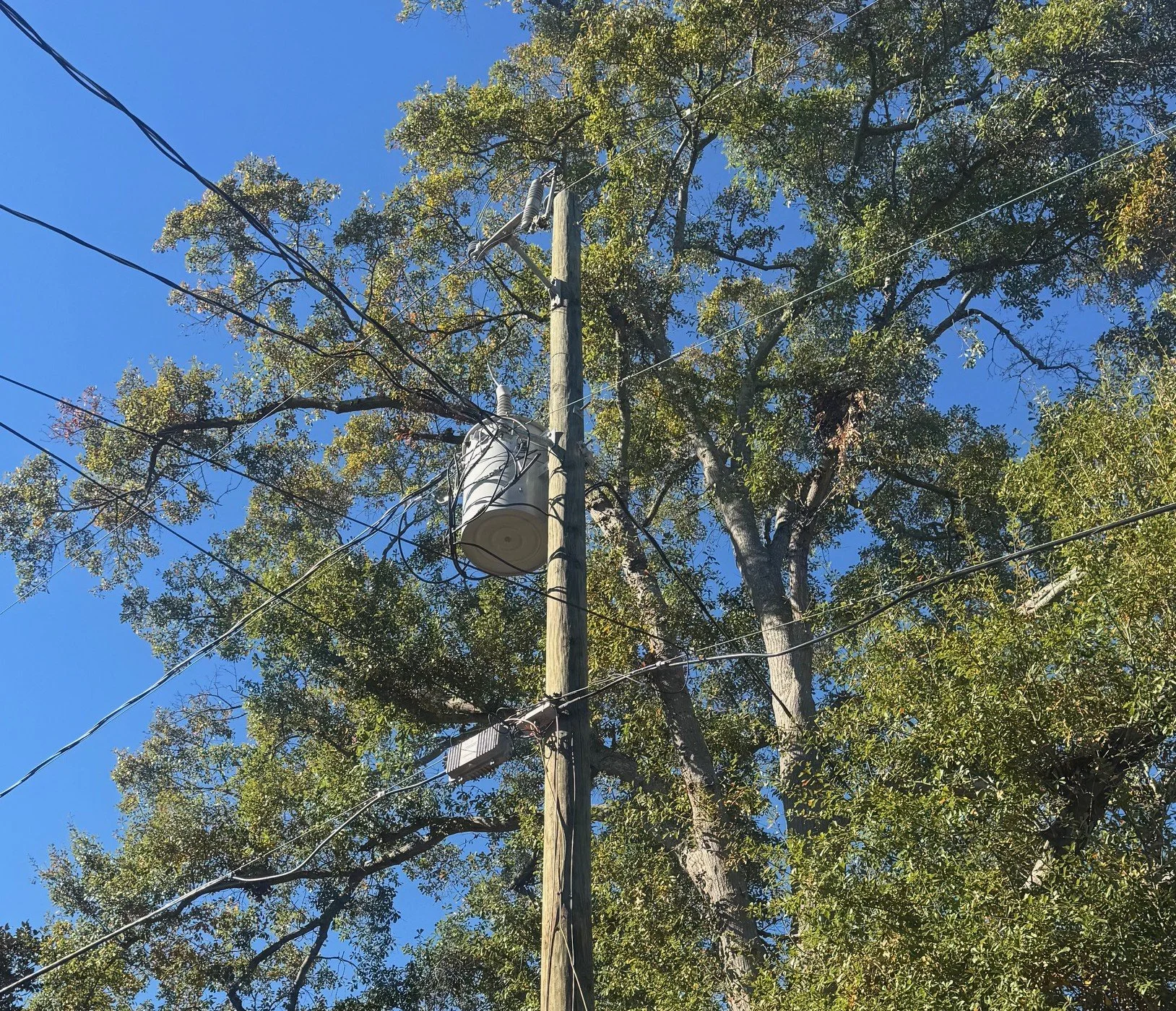
A pole-mounted transformer reduces distribution voltage for the customers it serves. Photo by Travis Basnett.
Your neighborhood is part of a larger network
Follow the wires away from your house and they eventually connect to larger distribution lines.
These are the wires you see running along major roads, often near the tops of utility poles. They're carrying electricity from substations toward neighborhoods, businesses, schools, and everything else connected to the system.
The larger circuits are called feeders. Smaller branches, sometimes called laterals or taps, extend from them to serve individual areas.
You can picture a feeder as the trunk of a tree, with branches extending into neighborhoods.
But unlike an actual tree, an electrical distribution system contains switches, fuses, circuit breakers, and other equipment that can separate one portion from another.
That is deliberate.
Imagine a tree falls across a power line serving one neighborhood. Without any way to isolate the damaged section, the failure could interrupt electricity to everyone served by the same upstream protective device.
Instead, utilities divide their networks into sections. Depending on where the fault occurs and how the circuit is protected, equipment can disconnect a smaller portion of the network while allowing electricity to continue reaching other customers.
This is one reason two houses separated by a single street can have completely different experiences during the same thunderstorm.
They might be connected to different transformers, different branches of the same feeder, or entirely different circuits. Even on the same feeder, nearby homes may be supplied through transformers connected to different phases. An interruption affecting one phase can leave some customers without power while others nearby remain supplied.
Being physically close doesn't necessarily mean sharing the same electrical connection.
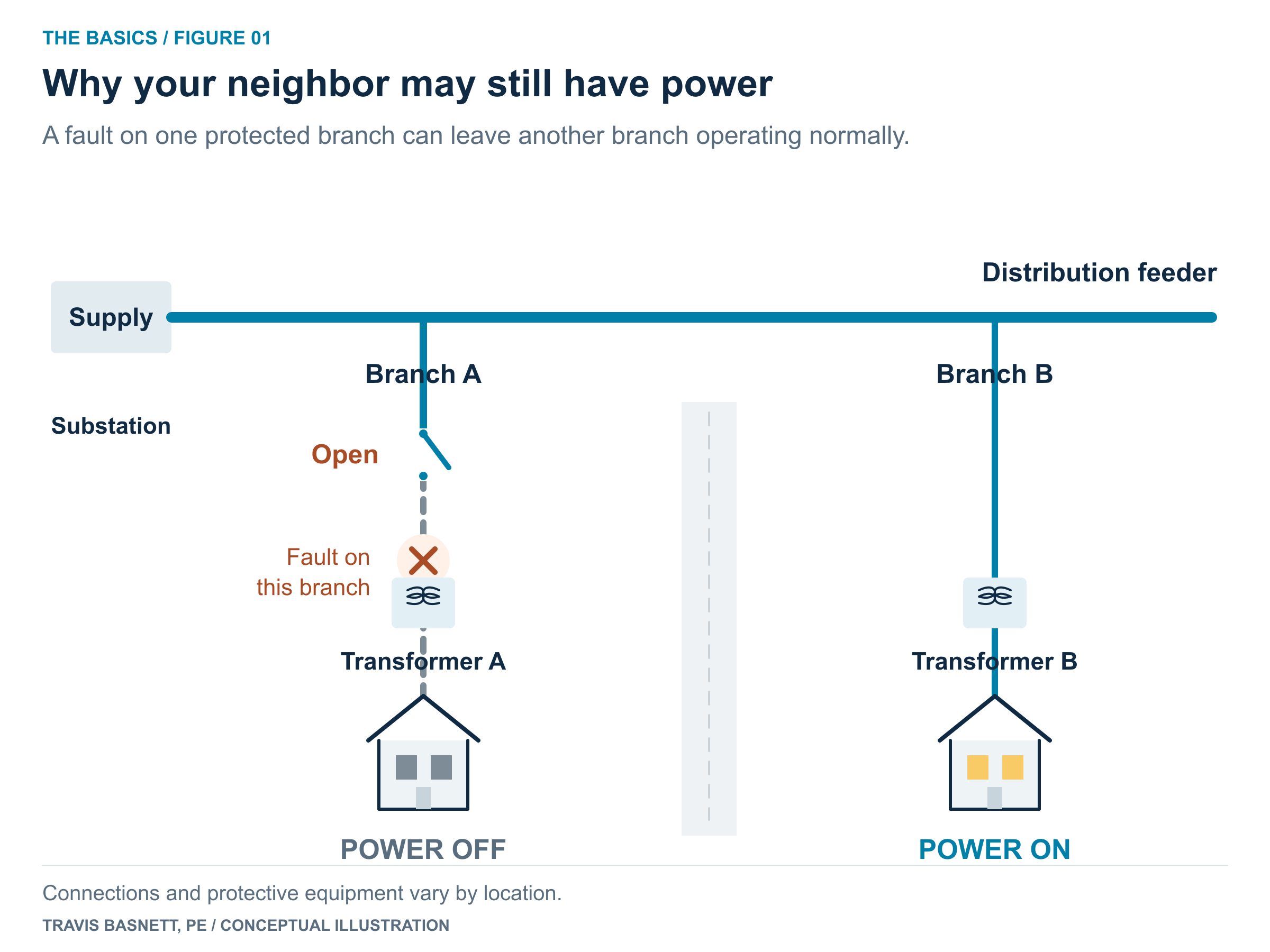
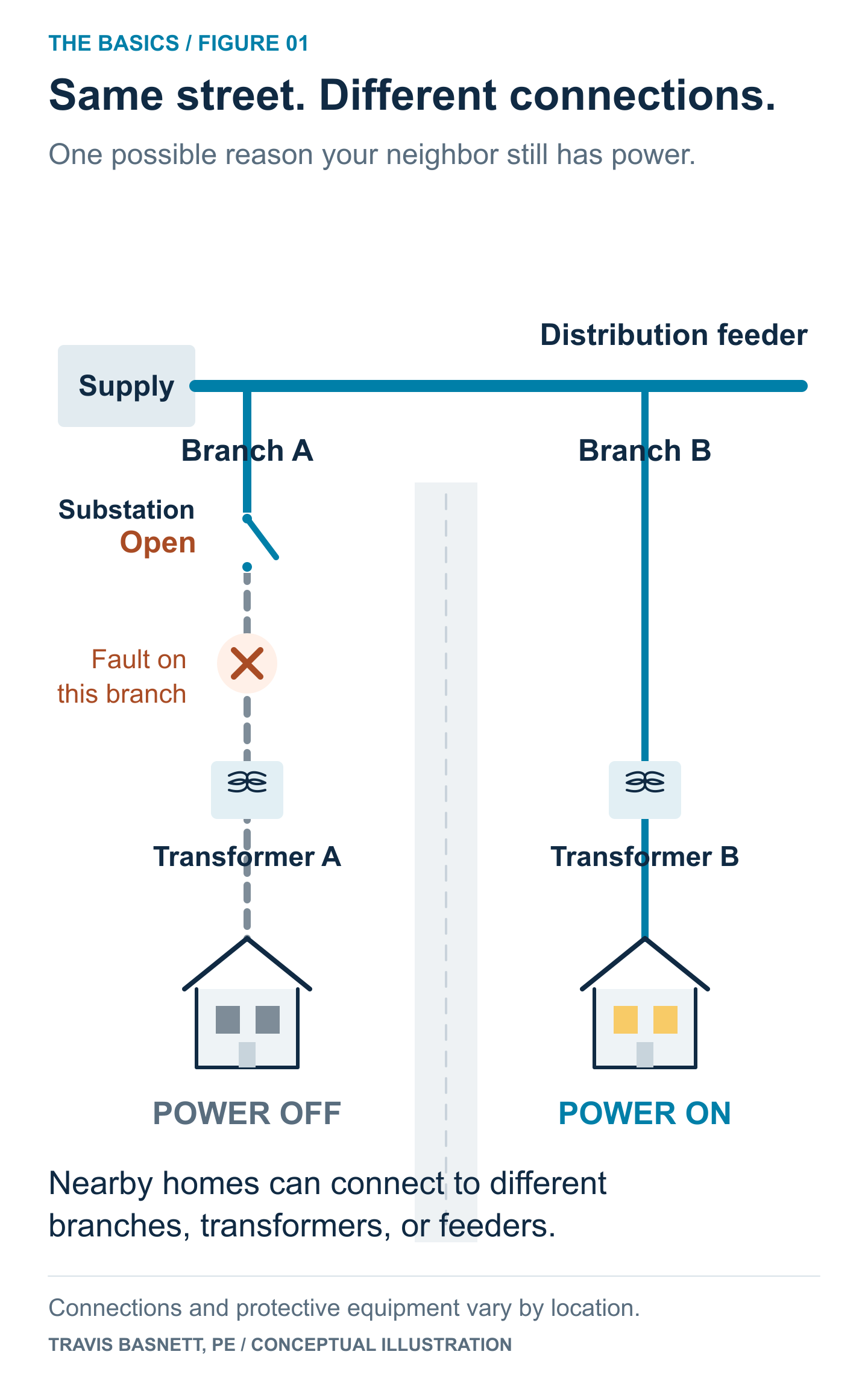
Figure 1. Homes on the same street can be served by different branches, transformers or feeders. When protection opens one branch, the other can keep operating.
And that brings us back to the flickering lights.
Why the lights blink
During our thunderstorm, imagine a large tree limb falling against an overhead distribution line.
Under normal conditions, electricity flows through the conductors along a designed path. When a branch contacts energized equipment, it can create an unintended path for current to flow.
Engineers call this a fault.
Depending on the circumstances, fault current can become extremely large, creating dangerous heat and potentially damaging wires, transformers, and other equipment.
The system needs to respond quickly.
This is where circuit breakers, fuses, and devices called reclosers come into play.
And that loud bang people describe as a transformer exploding? It may be a fuse operating. Some utility fuses interrupt fault current with a sharp report and a flash. Transformers can fail too, but a boom by itself doesn’t tell you which piece of equipment was involved.
A recloser is a protective switch designed to detect certain electrical faults, interrupt the current, and then automatically attempt to restore power.
Why would it turn the electricity back on after detecting a problem?
Because not every fault is permanent.
A tree branch might briefly touch a line during a strong gust, then fall away. An animal might contact electrical equipment and create a momentary fault. Lightning can cause a temporary electrical disturbance without leaving permanent damage.
If the problem has cleared, the circuit may be able to operate normally again.
So when certain protective devices detect a fault, they disconnect the affected circuit. After a short delay, they may reconnect it.
If the fault is gone, the power stays on.
If the fault remains, the device opens again. Depending on its settings, it may make additional attempts before remaining open until the problem can be investigated.
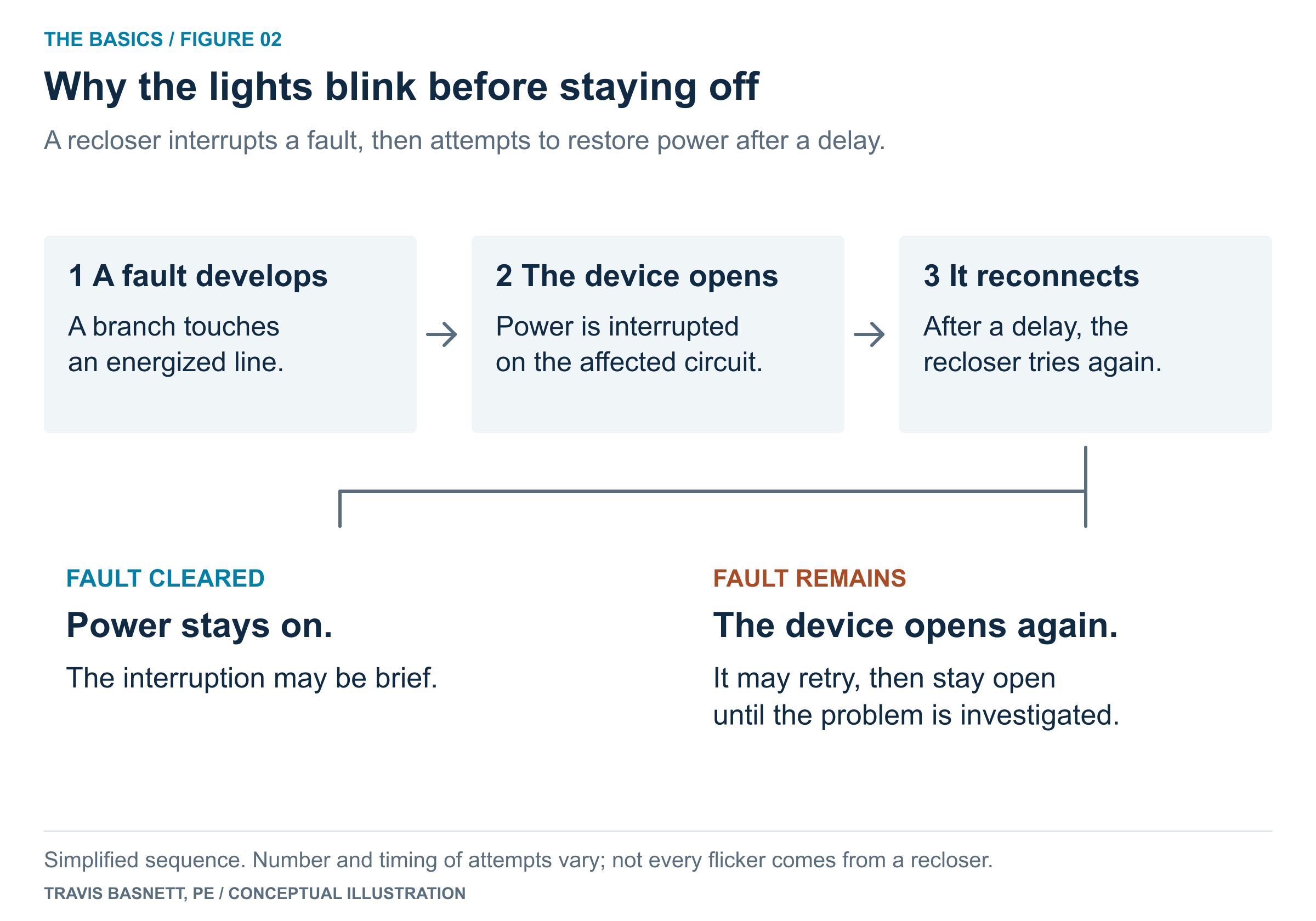
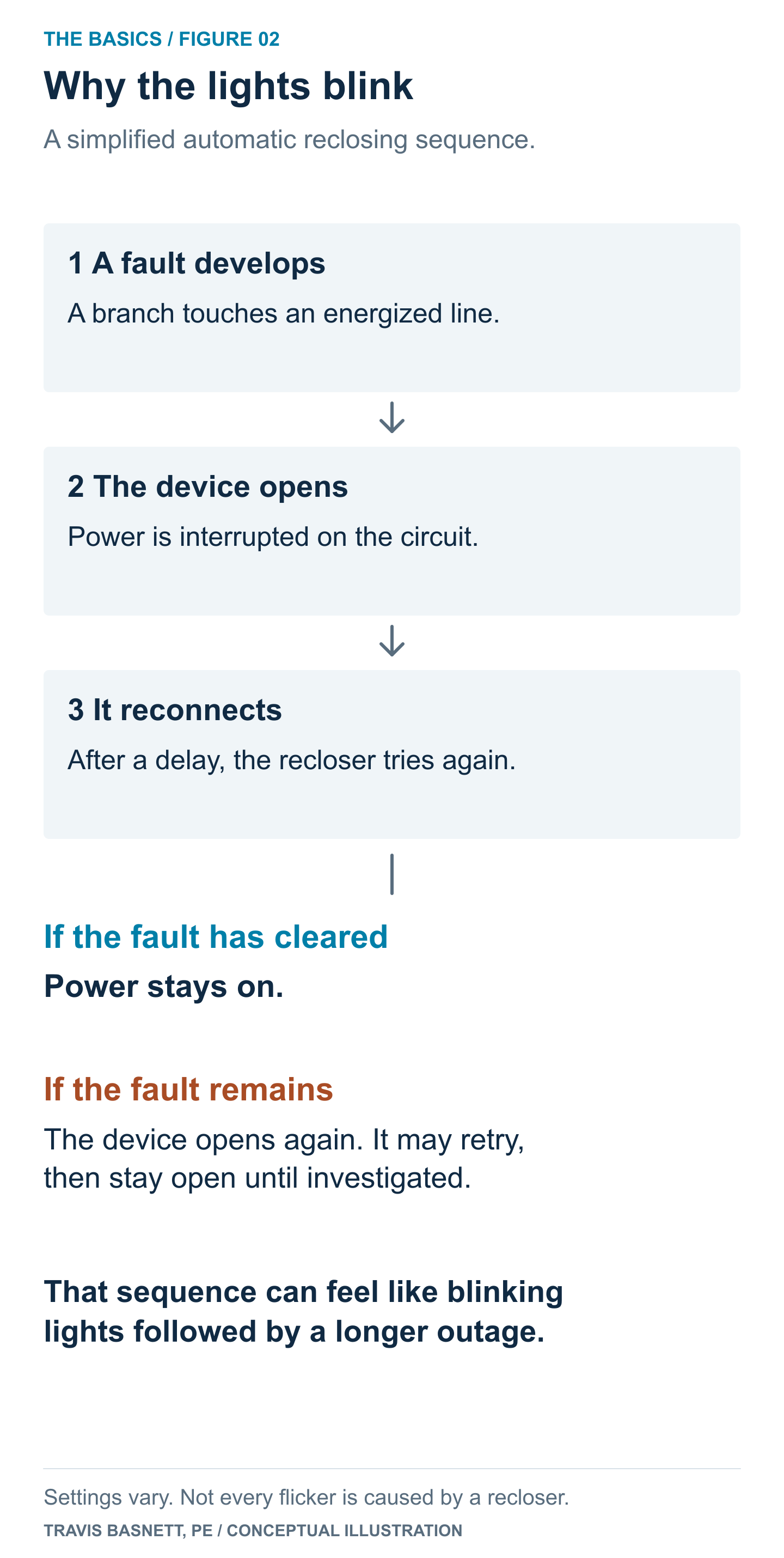
Figure 2. A simplified automatic reclosing sequence: interrupt, wait, try again, and stay open if the fault remains.
That's one explanation for the familiar sequence of lights blinking several times before going out completely.
The number and timing of those interruptions vary, and not every flicker comes from a recloser. But what feels like an unpredictable electrical problem may actually be protective equipment operating exactly as intended.
The grid didn't necessarily fail to respond.
It recognized a problem and deliberately disconnected part of itself.
Following the wires farther back
We've spent most of our time looking at the distribution system because that's where many ordinary storm-related outages occur.
Follow a distribution feeder far enough and you'll reach a substation: one of those fenced compounds filled with transformers, switches, insulators, and wires.
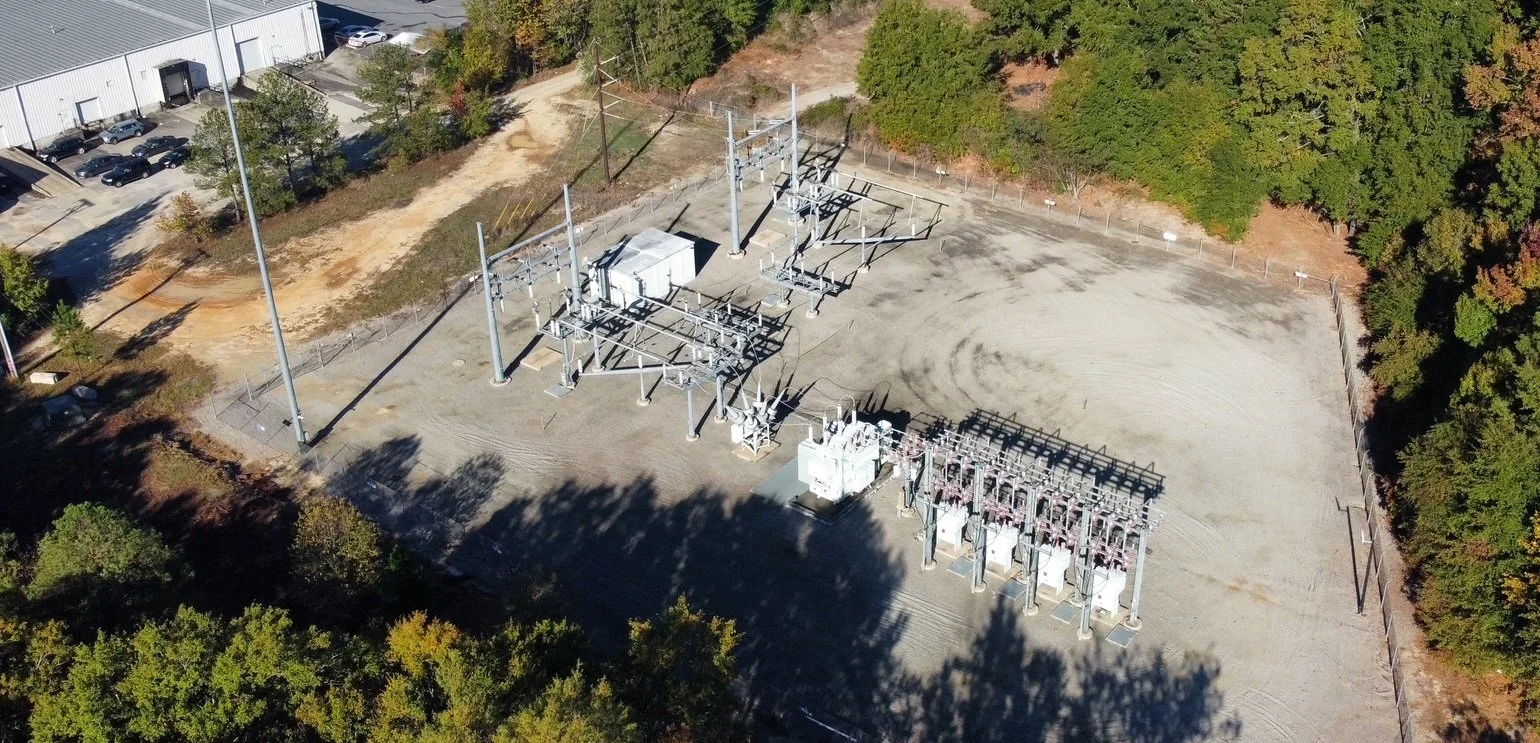
A substation connects parts of the electrical network and may reduce voltage for local distribution. During the storm described here, this equipment could still be operating normally while a damaged neighborhood line leaves some homes without power. Photo by Travis Basnett.
Many substations reduce transmission voltage to the levels used for local distribution. Beyond them, transmission lines connect the area to a broader grid supplied by many generating facilities.
Your house isn't necessarily receiving electricity from one particular power plant. Generation, demand, and available storage are continuously balanced across the network.
And here's something worth understanding about our thunderstorm:
The generating facilities may be operating normally. The transmission network may be unaffected. The local substation may still be supplying thousands of other customers.
The entire grid hasn't stopped working.
A relatively small section of the distribution network has been disconnected because something went wrong.
Which sounds simple enough to fix.
So why are you still sitting in the dark?
Knowing there's a problem isn't the same as knowing where it is
When your power goes out, the electric utility may know almost immediately.
Modern substations and distribution equipment can report information to utility control centers. Many homes also have smart meters that can notify the utility when service is interrupted.
In South Carolina, Dominion Energy uses smart meters that can report both outages and restorations.
But knowing that several hundred customers have lost power doesn't necessarily tell the utility exactly what caused it.
A protective device might identify an affected circuit. Meter information may help narrow the outage to a particular neighborhood or group of customers.
Neither necessarily tells a dispatcher that a pine tree fell across a line behind a house three streets over.
That requires more information.
Utilities combine equipment readings, outage reports, customer calls, mapping systems, and sometimes field inspections to determine where the problem occurred.
Imagine a feeder serving 2,000 customers.
After the storm, the utility receives reports from 400 homes, all clustered around several nearby streets. That pattern can help identify the affected section of the system.
But crews may still need to patrol the lines to find the actual damage.
And the damage isn't always obvious.
A tree may be hanging across wires behind a row of houses. A fuse may have operated on a pole tucked away from the road. An underground cable may have failed without leaving anything visible above ground.
The utility can know exactly which customers are without power and still need time to determine what must be repaired.
That's the first reason restoration can take longer than people expect.
Restoring power doesn't always require fixing everything first
Here's where the system gets especially interesting.
Suppose the tree in our example has damaged a section of distribution line serving 400 homes.
Depending on the configuration, utility operators may be able to open switches and isolate the damaged section from the rest of the network.
Once the affected section is safely isolated, they may be able to restore electricity to customers whose portion of the circuit is still intact.
Some systems can even transfer customers to an alternate feeder when sufficient capacity and suitable connections are available.
That means a utility might restore power to 350 homes without having repaired the tree-damaged line at all.
The remaining 50 houses still need the damaged section repaired before their electricity can return.
The equipment that disconnected the fault also helps limit how much of the neighborhood has to stay disconnected while repairs are made.
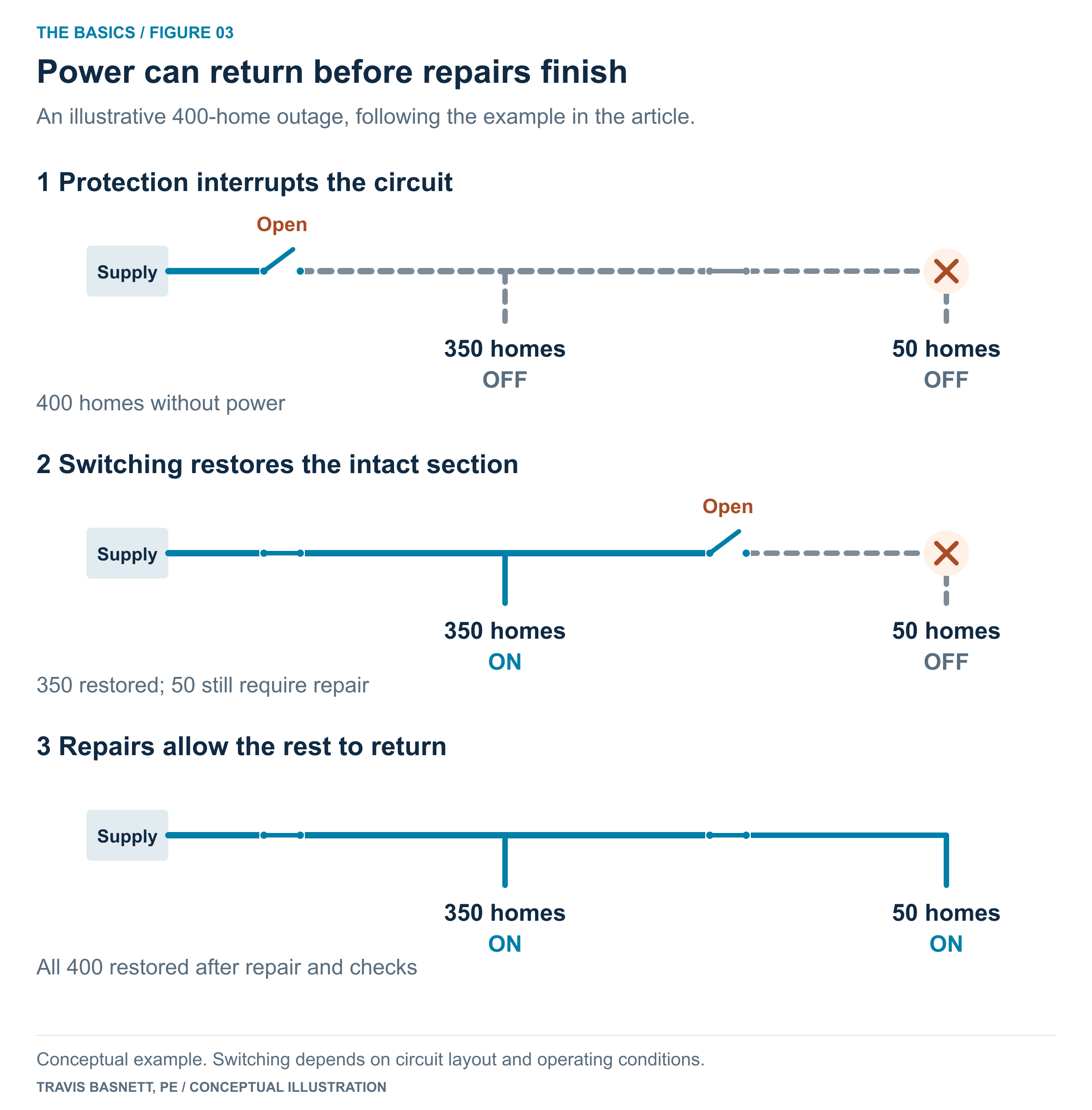
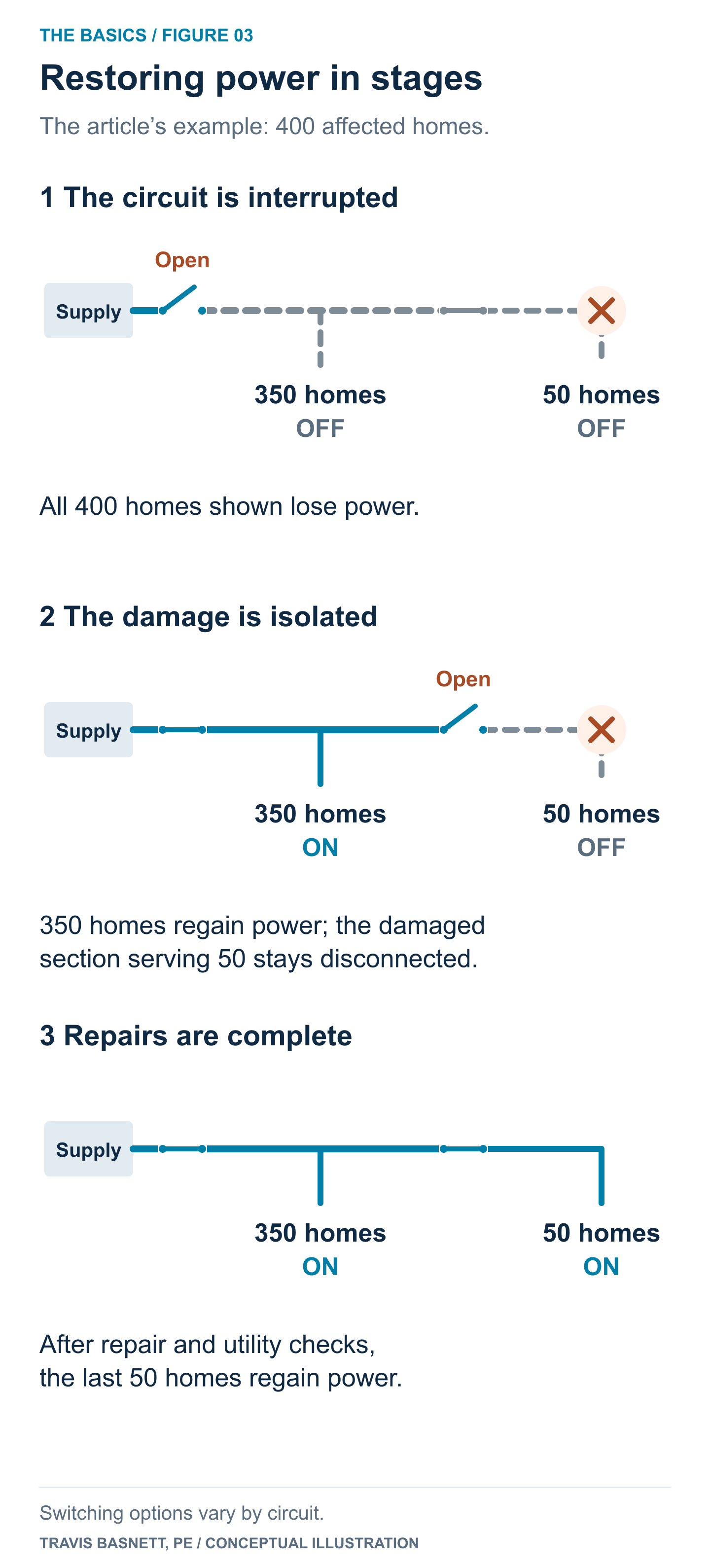
Figure 3. The 400-home example: switching restores the 350 homes on the intact section, while the 50 on the damaged section wait for repairs.
This helps explain something that can be particularly frustrating during an outage.
Your neighbor's power comes back.
Then the houses at the end of the street.
Then the neighborhood behind yours.
But your house is still dark.
It doesn't necessarily mean anyone forgot about you. It may mean the utility successfully isolated the fault, restored everyone it could, and left only the section that requires physical repairs disconnected.
Sometimes restoring a large portion of an electrical circuit is a matter of operating switches.
Restoring the last few houses may require an entirely different kind of work.
Someone still has to fix the problem
A computer can identify an outage. A switch can isolate a fault. Neither can remove a fallen tree or replace a damaged utility pole.
Eventually, somebody has to go into the field.
Consider what that involves after a strong thunderstorm.
Crews need to locate the damage, evaluate the condition of the equipment, make the work area safe, and determine what repairs are necessary.
If a tree has fallen across energized lines, the work may require coordination between electrical line crews and specialized tree-clearing crews.
If the wires are damaged, they may need to be replaced. If a pole is broken, a new pole may have to be installed, along with its supporting equipment and connections.
Even reaching the failure can be a challenge.
Electrical easements sometimes run behind houses, through wooded areas, or across property that becomes difficult to access after heavy rainfall.
A utility truck that can easily reach a pole beside a paved highway might have no direct access to a damaged line behind a subdivision.
And just because a line appears to be disconnected doesn't mean it is safe to touch. Electrical crews follow specific procedures to isolate equipment, verify its condition, and protect workers before repairs begin.
Once the repairs are complete, the utility still has to confirm that the affected circuit can safely be returned to service.
The repair itself may be relatively straightforward. Getting the right people and equipment to the right location, safely completing the work, and restoring the circuit can take considerably longer.
This is the part of the outage you don't see from your living room.
Why some neighborhoods get power back first
Now imagine the same thunderstorm caused ten separate outages across town.
The utility has multiple crews available, but not enough to repair everything simultaneously.
Which outage should they address first?
It's tempting to think they simply work through the reports in the order they arrive.
But that isn't how restoration is generally organized.
Public safety hazards come first. Downed energized wires, damaged equipment, and other dangerous conditions need to be addressed before they injure someone.
Critical facilities such as hospitals, emergency services, and water or wastewater facilities also receive priority.
Beyond that, utilities generally focus on restoring larger portions of the network before smaller individual connections.
A damaged feeder might affect 3,000 customers. A broken service line might affect one house.
Repairing the feeder can restore electricity to thousands of people, while fixing the individual service line restores power to one.
There are exceptions, and several repairs may happen at once. The severity of the damage, crew availability, accessibility, and the amount of work involved all influence the order.
But there's a basic principle behind the process:
Restore power safely to as many customers as possible, as efficiently as possible.
That's why seeing a utility truck drive past your neighborhood doesn't necessarily mean your outage is being ignored.
The crew may be headed to a problem that affects your neighborhood and several others, even though the damaged equipment is miles away.
It also explains why restoration estimates change. Until crews inspect the damage, the utility may not know whether it needs to replace a fuse, remove a tree, or rebuild several spans of power line.
Those are very different jobs.
Why don't we just bury the lines?
If falling trees cause so many power outages, the obvious question is why we don't simply put every electrical line underground.
It's a reasonable question.
And in many new residential developments, underground electrical distribution is already common.
Buried cables are protected from several things that routinely damage overhead lines, particularly wind, falling branches, and ice accumulation.
But underground electrical infrastructure has its own challenges.
First is cost.
Installing underground utilities involves excavation or directional drilling, conduit or direct-buried cable, specialized electrical equipment, and coordination with everything else already beneath the ground.
There may be water mains, sewer lines, gas lines, telecommunications cables, drainage systems, and other infrastructure competing for space.
Installing underground service in a new subdivision before the streets are paved is one thing.
Converting an established neighborhood with mature trees, driveways, sidewalks, landscaping, and existing utilities is something else entirely.
The second issue is maintenance.
When an overhead line fails, the damage may be visible from the ground.
When an underground cable fails, crews may need specialized testing to locate the fault. Repairing it can require excavation, replacement cable, or access to underground connections.
Underground systems often experience fewer weather-related interruptions, but individual failures can take longer to locate and repair.
And burying the wires in your neighborhood doesn't eliminate every outage. Those cables still connect to upstream infrastructure that may remain overhead.
Underground construction is an important tool for improving reliability. It just isn't a universal solution.
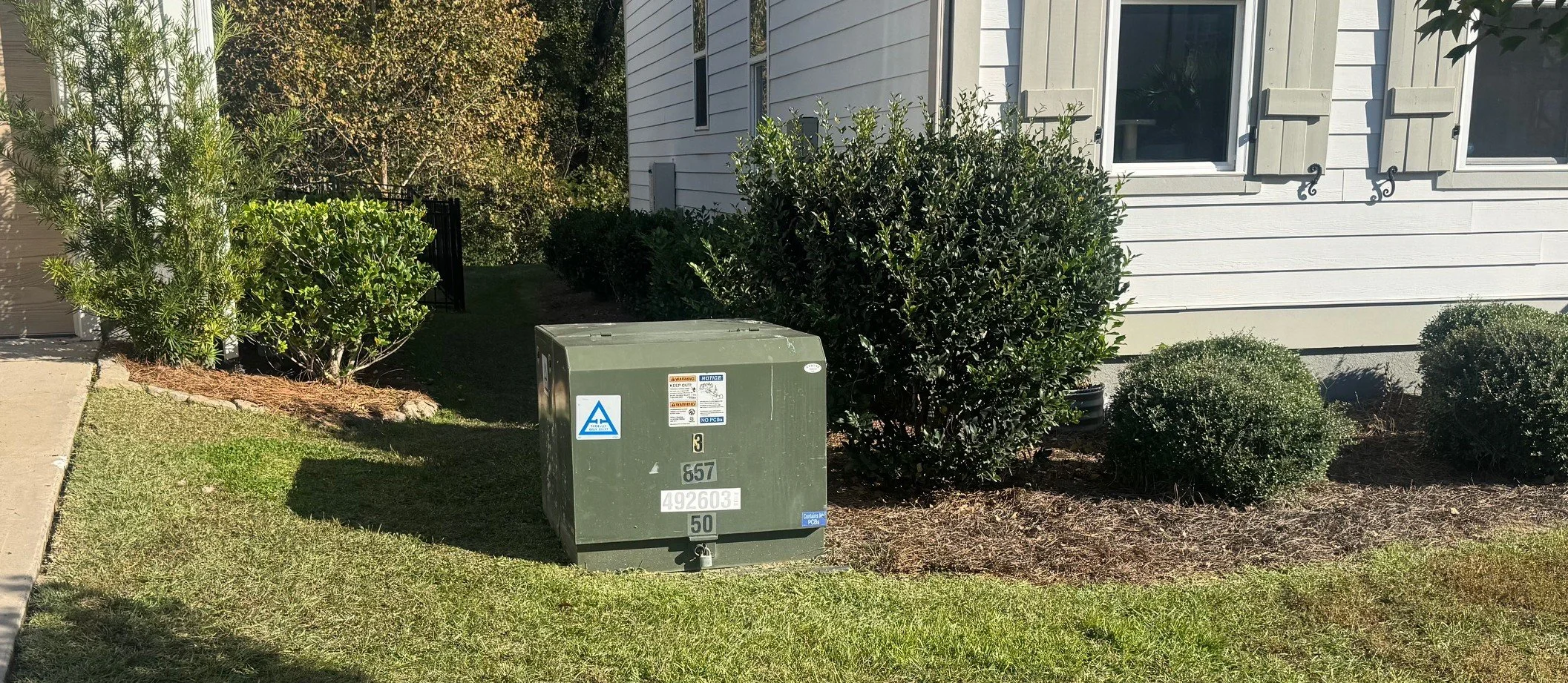
A pad-mounted transformer serves underground electrical distribution in a residential neighborhood. Photo by Travis Basnett.
Back in your living room
Let's return to the house where we started.
The thunderstorm has passed. The rain has slowed, and the last of the thunder is moving away.
Your phone now shows an estimated restoration time.
A crew has located the fallen tree. The damaged section has been isolated, allowing most of the surrounding neighborhood to regain power.
Your house happens to be among the remaining customers still connected to the affected section.
Eventually, the tree is cleared, the damaged equipment is repaired, and the utility is ready to restore service.
Then, without warning, the lights come back on.
The refrigerator starts humming. The air conditioner kicks on. The clock on the microwave is blinking.
To you, it was an inconvenience that lasted several hours.
But behind that interruption was a network of protective devices, control systems, utility operators, switches, transformers, and line crews working to identify a problem, keep it from spreading, and restore service.
The most important part of the electrical grid isn't simply that it delivers power.
It's that the system is designed to recognize certain failures, disconnect damaged sections, and allow the rest of the network to keep operating wherever possible.
The next time your lights flicker during a thunderstorm, you might be watching that protection system at work.
And when the power finally comes back on, you now have a better idea of what it took to get there.
Sources
[2] Dominion Energy South Carolina, Smart Meter: outage and restoration reporting.
From the same series
What Happens When You Turn On the Faucet? Follow the public water system backward, from the tap to its source.
What Happens After You Flush? Follow wastewater in the other direction.
What Happens When It Rains? Where rain goes after it falls.
What Happens When You Drive to Work? Why every road on your commute is built for a different job.
What Happens When You Drive Over a Bridge? Follow your car’s weight from the tire to the dirt.
What Infrastructure Does a Data Center Actually Use? How a data center’s design determines what it needs from the infrastructure around it.
What Happens Before a New Neighborhood Is Built? Follow one wooded tract from 100 imagined lots to a workable plan for 72.
This article is part of a series explaining how the systems around us actually work, written for people who are not engineers.
Curious how a system near you actually works? I write these to make everyday infrastructure legible. I also provide expert witness support and limited independent technical review for civil site, drainage and utility infrastructure disputes.
About the Author
Travis Basnett, PE is a civil engineer who has practiced since 2010 in civil site development, stormwater design, drainage evaluation, and flooding investigations. He provides expert witness support and independent technical review for civil engineering disputes and is licensed in South Carolina, North Carolina and Georgia.
Disclaimer: This article is intended for general informational purposes and does not constitute legal or engineering advice regarding any specific property, project or matter.
Graphics note: The diagrams in this article were created with AI assistance and reviewed by the author. They are simplified and not to scale.